











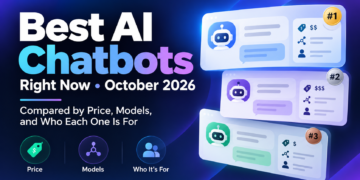





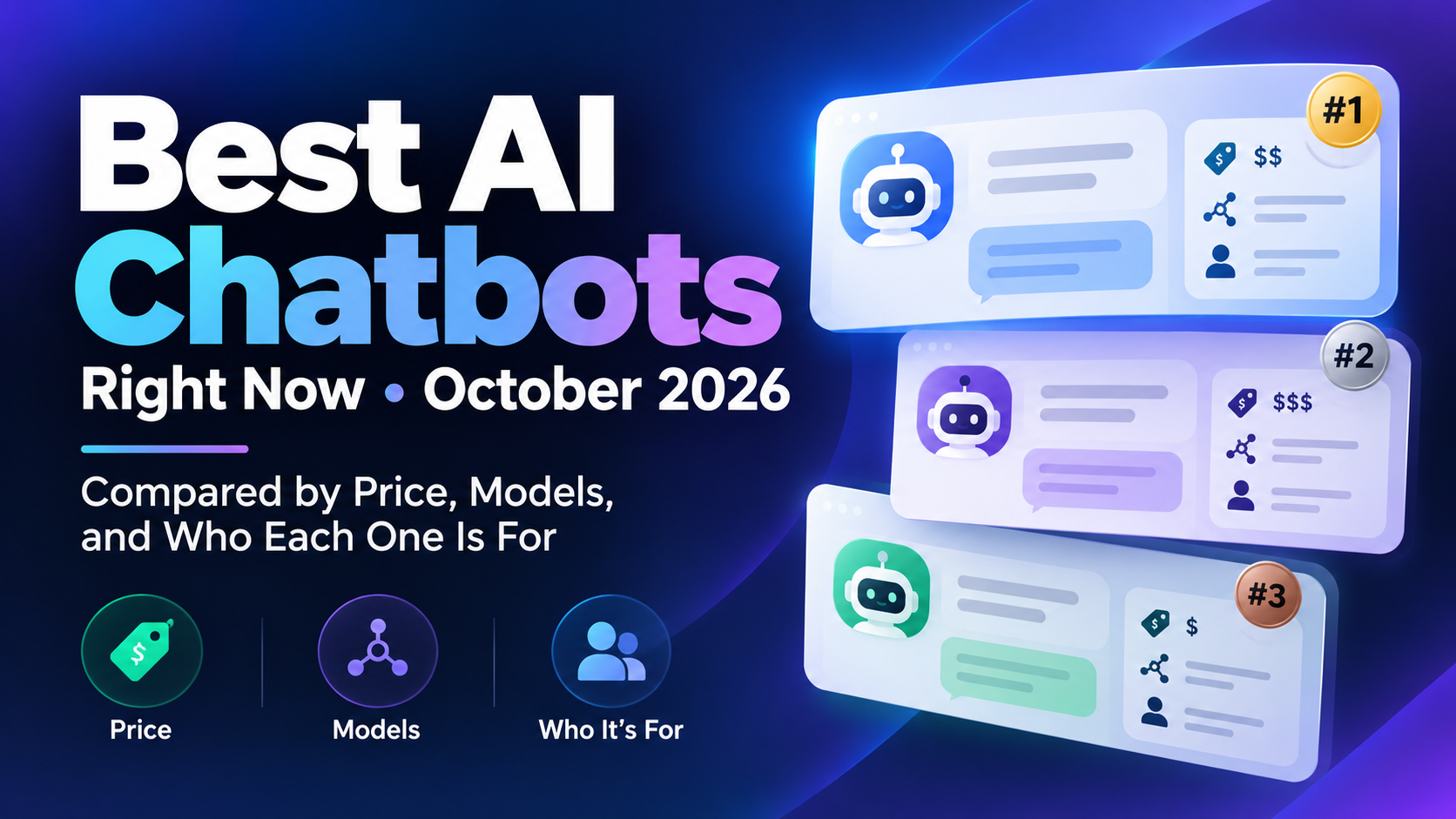
Best AI Chatbots Right Now (October 2026): Compared by Price, Models, and Who Each One Is For
Three weeks ago, “which AI chatbot should I use?” had a different answer. Since then, OpenAI moved ChatGPT to its GPT-6 models, Google cut the free Gemini plan to a single small model and then opened its new Gemini 4 Argon to paying users, Anthropic made document and slide tools free in Claude, and xAI reshuffled its Grok plans. Prices and limits are moving almost weekly.
This guide compares the seven chatbots most people actually consider, as of October 17, 2026. For each one you’ll see what the free plan gives you, what the paid tiers cost, and who it fits. There is no single best chatbot, only a best one for your situation, so the goal is to help you pick quickly and avoid paying for the wrong thing. All prices are US list prices and can differ by country and tax.
The Quick Answer
- Best all-rounder: ChatGPT, for the widest set of features and a very capable free tier.
- Best for writing and long documents: Claude, especially now that Docs, Slides, and Design are free.
- Best if you live in Google’s world: Gemini, mainly on the $19.99 plan.
- Best for cited research: Perplexity.
- Best if you work in Microsoft Office: Microsoft Copilot.
- Best for real-time social context: Grok.
- Best completely free option: DeepSeek, with caveats below.
1. ChatGPT (OpenAI)
ChatGPT is still the default choice for most people, and its latest change matters. Since October 7 and 8, regular chat has run on GPT-6: GPT-6 Sol for paid users on Plus and above, and GPT-6 Luna for Free and Go users, along with an “Intelligent UI” that can answer with charts, buttons, and small calculators.
Plans (US): Free at $0, Go at $8, Plus at $20, and Pro at $100, $200, or $500 depending on usage. Business starts at $25 per seat per month, or $20 on annual billing.
What you get:
- Free and Go: GPT-6 Luna in chat. Go raises the limits on images and uploads, and may show ads.
- Plus: the stronger Sol model, plus deeper research and Codex for coding. GPT-6 Astra is limited to the Work and Codex tools on this tier.
- Pro: GPT-6 Astra in regular chat, and much higher usage.
Best for: general use, brainstorming, coding help, and anyone who wants one tool that does a bit of everything.
Watch out for: the plan names are confusing, since there are now three Pro tiers. Sources also disagree on small details, such as exactly which model the free tier uses in every app, so check OpenAI’s pricing page before upgrading.
2. Claude (Anthropic)
Claude stands out for clear writing, careful reasoning, and long documents. On October 8, Anthropic made Claude Docs, Slides, and Design available on every plan, which makes the free tier more useful for creating things, not just chatting.
Plans (US): Free at $0, Pro at $20 a month or $17 billed annually, Max at $100 or $200, and Team seats from $25.
What you get:
- Free: Sonnet and Haiku models, with usage limits that reset on a rolling five-hour window. It doesn’t include Opus.
- Pro: Claude Opus 5.5 (released September 22), Claude Code, and at least five times the free usage per session.
- Max: five or twenty times the Pro usage, plus access to the top Fable 5.1 model for up to half of your weekly limit.
Best for: writing, editing, document-heavy work, and coding. See our step-by-step guide to making presentations and documents with Claude for free.
Watch out for: the free allowance is the smallest of the major chatbots, so a long session can run out quickly. For more on current plan details, see Lindy’s pricing breakdown.
3. Gemini (Google)
Gemini had the most dramatic month. On October 9, free accounts were limited to the small Flash-Lite model, and Google AI Plus lost access to the Pro model. Then on October 13, Google opened Gemini 4 Argon, its new flagship, to Google AI Pro and Ultra subscribers in the Gemini app.
Plans (US): Free at $0, Google AI Plus at $4.99, Google AI Pro at $19.99, and Google AI Ultra at $99.99 or $199.99.
What you get:
- Free: Flash-Lite only, with usage caps.
- Plus ($4.99): Flash-Lite and Flash, roughly double the free usage, and 400 GB of storage.
- Pro ($19.99): all models, Deep Think, Gemini 4 Argon, a one-million-token context window, and 5 TB of storage.
- Ultra: five or twenty times the Pro usage, and the most advanced features.
Best for: people who already use Gmail, Docs, Drive, or Android, and anyone who wants storage and AI in one subscription. FelloAI’s Gemini guide tracks the plan changes.
Watch out for: the free plan is now noticeably weaker than it was in the summer, and plan details change by region and by account, so check Google’s own help page for your account.
4. Grok (xAI)
Grok is built around real-time information from X and fast-moving news. xAI changed its plan lineup on October 12, and older pages still show the previous SuperGrok names, so confusion is common.
Plans (US, reported): a limited free tier, then paid tiers around $8, $30, $100, and $200 a month under the X Subscription branding, per Tech Insider’s pricing comparison. The $30 plan is the one comparable to the $20 plans from rivals, which makes Grok about 50% more expensive at the standard tier.
Best for: current events, social media context, and people who already pay for X.
Watch out for: the pricing ladder has just been reshuffled, so confirm what each tier includes before subscribing.
5. Microsoft Copilot
Copilot makes the most sense inside Microsoft’s apps. There’s a free version for quick questions, and Microsoft 365 Premium at $19.99 a month (or $199.99 a year) replaced the old Copilot Pro plan, adding AI to Word, Excel, PowerPoint, and Outlook.
Best for: people who spend their day in Office, especially for drafting documents, analyzing spreadsheets, and building slides.
Watch out for: the AI features are tied to the account owner, even if you share the Microsoft 365 subscription with family members, and the free version has reduced caps.
6. Perplexity
Perplexity is closer to a search engine than a chat assistant. It answers with linked sources, which makes it easier to check claims.
Plans (US): Free, Pro at $20 a month ($17 on annual billing), and Max at $200. Pro lets you switch between several underlying models and raises the number of advanced searches considerably.
Best for: research, fact-checking, and exploring unfamiliar topics.
Watch out for: a citation doesn’t guarantee a claim is correct, so open the source before you rely on it. The free plan caps advanced searches at just a few per day.
7. DeepSeek
DeepSeek offers a free web and mobile chat with no paid consumer tier at all, powered by its V4-series models. It’s popular with people who want strong reasoning without paying.
Best for: budget-conscious users and anyone who just wants capable answers for free.
Watch out for: data handling and local rules. Check the privacy policy and whether your school, employer, or government restricts the app before using it for anything sensitive. Reliability can also vary, since DeepSeek reported a five-hour API outage on October 15.
Also worth knowing: Meta AI is free with no confirmed consumer paid tier, and Mistral’s Le Chat has a paid plan at about $15 a month, according to one comparison site.
Price Comparison at a Glance
| Chatbot | Free tier | Entry paid | Standard paid | Top consumer tier |
|---|---|---|---|---|
| ChatGPT | Yes (GPT-6 Luna) | Go $8 | Plus $20 | Pro up to $500 |
| Claude | Yes (Sonnet, Haiku) | None | Pro $20 ($17 annual) | Max $200 |
| Gemini | Yes (Flash-Lite only) | AI Plus $4.99 | AI Pro $19.99 | Ultra $199.99 |
| Grok | Limited | About $8 | About $30 | About $200 |
| Copilot | Yes | None | Microsoft 365 Premium $19.99 | Not offered |
| Perplexity | Yes | None | Pro $20 ($17 annual) | Max $200 |
| DeepSeek | Yes | None | None | None |
Four of the five big vendors now charge almost exactly the same at the standard tier, around $20 a month, as one October comparison points out. That makes the choice about features and ecosystem, not price.
Free Tier Showdown: What You Get for $0
If you’re not ready to pay, here’s how the free plans stack up right now:
- ChatGPT Free: the most generous overall, with a current-generation model and a broad feature set.
- Claude Free: strongest for writing and creating documents, but the smallest usage allowance.
- Gemini Free: now limited to Flash-Lite, so it’s best for quick, simple questions.
- DeepSeek: fully free, with strong reasoning but the data and reliability caveats above.
- Perplexity Free: good for occasional cited answers.
Our guide to free AI tools for students shows how to stretch these free plans for schoolwork.
Which Chatbot Should You Choose?
| If you are… | Start with | Why |
|---|---|---|
| A student on a budget | ChatGPT Free or Claude Free | Capable models at no cost |
| A writer or consultant | Claude Pro | Clear writing and long-document handling |
| A freelancer who needs everything | ChatGPT Plus | Broadest tool set |
| A researcher | Perplexity Pro | Sourced answers |
| A Google Workspace user | Google AI Pro | Integration and storage |
| An Office power user | Microsoft 365 Premium | Copilot inside Word and Excel |
| A developer | ChatGPT Plus or Claude Pro | Coding tools on both |
How to Choose Without Wasting Money
- Test the free tiers first. Run the same three real tasks through two chatbots and compare the results.
- Pay for one at a time. Subscribing to all of them costs well over $100 a month.
- Upgrade only when a limit actually blocks you. Hitting a usage cap mid-task is a better reason to pay than a new model name.
- Consider annual billing. Claude and Perplexity both discount annual plans to about $17 a month.
- Recheck every few weeks. Plans changed several times this month alone, and our roundup of the latest ChatGPT, Claude, and Gemini updates tracks the changes.
Common Mistakes
- Choosing by a single benchmark. A model that tops a leaderboard may not fit your daily tasks.
- Trusting outdated comparisons. Many guides still describe Gemini’s old free plan or Sora-era features.
- Ignoring usage limits. Two plans at the same price can have very different allowances.
- Pasting sensitive data without checking settings. Review each app’s data and training controls first.
- Treating answers as facts. Every chatbot can be wrong, so verify anything important.
Frequently Asked Questions
What is the best free AI chatbot right now? For most people, ChatGPT’s free plan offers the best mix of capability and features. Claude is better for writing, and DeepSeek is free with no paid tier, though with data caveats.
Is ChatGPT or Claude better? They suit different jobs. ChatGPT has the broader toolset, while Claude is often preferred for writing and long documents. Both cost $20 a month at the standard paid tier.
Did Gemini get worse? The free plan did. Since October 9 it uses only Flash-Lite, while paying Pro and Ultra subscribers gained access to Gemini 4 Argon on October 13.
Which AI chatbot is cheapest? Google AI Plus at $4.99 and ChatGPT Go at $8 are the cheapest paid plans from major labs, and several chatbots are fully free.
Do I need more than one chatbot? Not usually. Most people do well with one paid plan, plus free tiers of others for comparison.
The Bottom Line
The chatbot market in October 2026 is closer than ever, with four major vendors charging about $20 a month and offering strong models. The real differences are in ecosystem, free-tier generosity, and the kind of work you do. Start by testing the free plans on your own tasks, upgrade only the one that actually hits a limit, and recheck every month or two, because this market keeps changing. If you’re deciding based on earning potential rather than comfort, our guide to free AI tools that can help you make money is a good next read.