

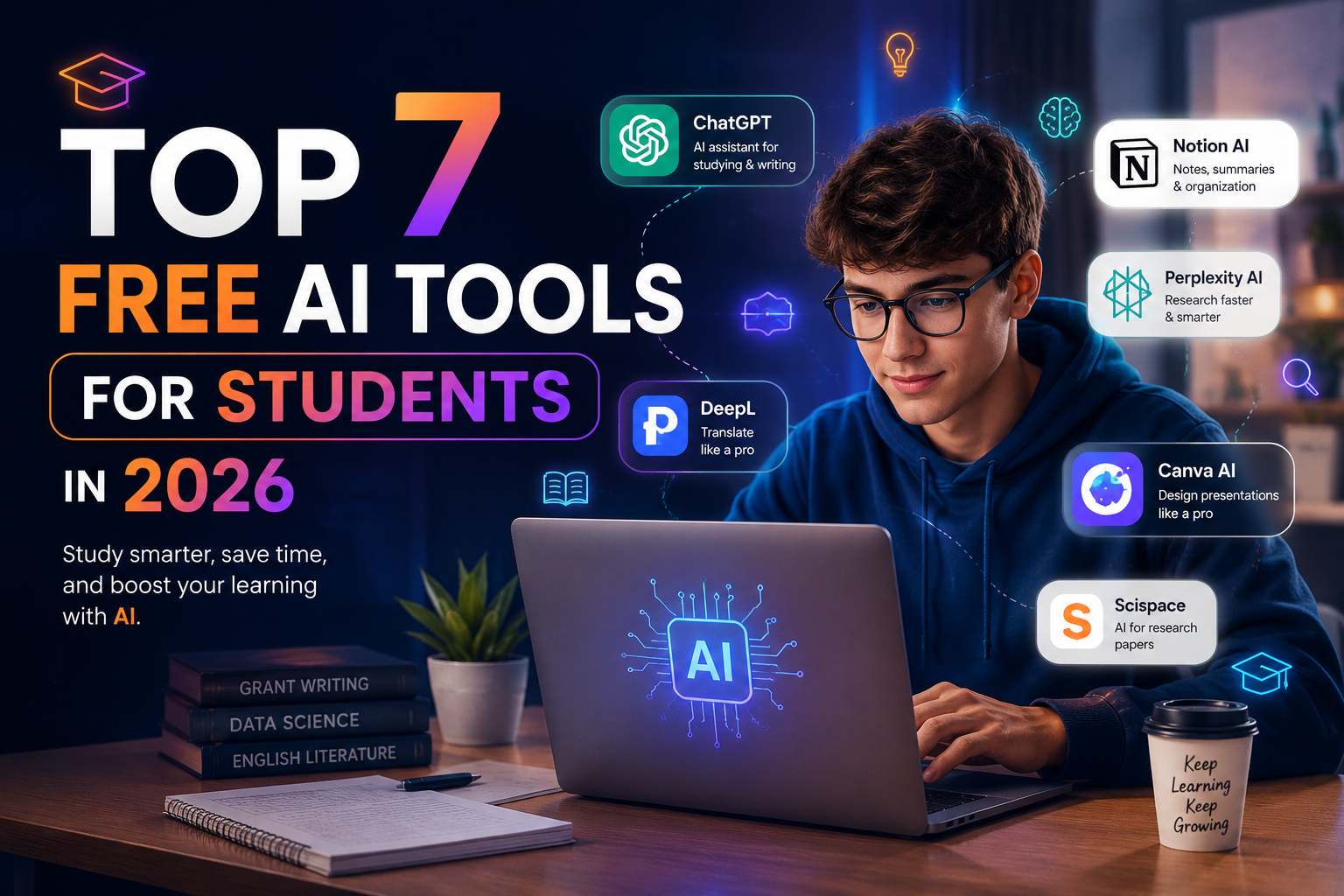
Ai is no longer a novelty for students — it’s part of how coursework actually gets done in 2026. The problem isn’t finding an AI tool anymore. It’s finding one that’s genuinely free, not just “free for five minutes before the paywall hits.”

Below are 7 free AI tools that cover the jobs students actually need done: writing, research, studying from your own materials, math, presentations, and code. You don’t need all seven. Pick the one or two that match your workload, and skip the rest.
1. ChatGPT (Free Plan)
Best for: brainstorming, explanations, and general homework help
ChatGPT remains the default starting point for most students, and for good reason — it’s flexible enough to help brainstorm an essay outline, explain a confusing concept in plain language, debug a piece of code, or draft a first pass at an assignment. The free plan gives access to a capable model with no daily cap that would block a normal study session.
The catch: it’s a general-purpose tool. It doesn’t know your specific course material unless you paste it in, and it can occasionally get technical details wrong — always double-check facts and citations before submitting anything.
2. Google NotebookLM
Best for: studying from your own lecture notes, textbooks, and PDFs
NotebookLM works differently from a typical chatbot: instead of pulling answers from the open internet, it only answers based on documents you upload — lecture slides, textbook PDFs, research papers, or your own notes. That constraint is actually the feature. It can’t hallucinate details about your specific course because it’s limited to what you actually gave it.
Upload your reading list before an exam and ask it to summarize themes, compare arguments across sources, or generate practice questions. It’s completely free with a Google account, with no daily limit on its core features. It also includes an Audio Overview feature that turns dense readings into a podcast-style conversation — genuinely useful for auditory learners reviewing material on a commute.
3. Wolfram Alpha
Best for: math, statistics, and science problem-solving
For STEM students, Wolfram Alpha remains the most reliable free option for verifying calculations, plotting functions, or working through multi-step math and physics problems. Unlike a general chatbot, it’s built on computational logic rather than a language model, so it’s less prone to arithmetic mistakes.
It won’t write your essay or explain historical context, but for checking whether your derivative or integral is actually correct, it’s still hard to beat.
4. Grammarly (Free Plan)
Best for: polishing grammar, clarity, and tone before submission
Grammarly’s free tier catches spelling and grammar errors, flags awkward sentence structure, and gives basic tone suggestions — a genuinely useful last pass before turning in an essay, lab report, or email to a professor. It works as a browser extension, so it checks your writing wherever you’re typing, not just inside one app.
The free plan is more limited than the paid version (advanced tone rewrites and plagiarism checking sit behind a paywall), but the core grammar and clarity checks are solid on their own.
5. Perplexity AI
Best for: research that needs actual sources
Perplexity functions like a search engine crossed with a chatbot: ask a question, and it returns an answer built from current web sources, with citations attached to each claim. For research papers or fact-checking, that citation trail matters — it lets you verify a claim actually says what the AI says it says, rather than taking the answer on faith.
One honest caveat that applies to any AI research tool: a citation next to a claim doesn’t automatically make the claim correct. Click through and read the actual source before using it in your work.
6. Gamma AI
Best for: turning notes into a presentation fast
Gamma generates a full slide deck — layout, structure, and basic design — from a topic prompt or a block of text you paste in. For group projects or last-minute presentations, it can take a rough outline and turn it into something presentable in minutes rather than hours spent fighting with PowerPoint templates.
The free plan caps the number of AI-generated decks per month, but it’s enough for regular coursework use without hitting a paywall on day one.
7. GitHub Copilot (Free for Students)
Best for: learning to code and debugging faster
Students with a verified academic email can get GitHub Copilot free through the GitHub Student Developer Pack. Copilot suggests code completions and can explain what an unfamiliar piece of code is doing — useful both for finishing an assignment faster and for actually understanding the syntax and logic behind it, rather than just copying a solution.
It works directly inside popular editors like VS Code, so it fits into a normal coding workflow instead of requiring you to switch between a chatbot tab and your IDE.
How to Actually Pick
Most students don’t need all seven of these running at once — that just creates more open tabs, not more productivity. A reasonable starting kit looks like this: one general assistant (ChatGPT) for brainstorming and explanations, one tool that works from your own material (NotebookLM) for exam prep, and one writing checker (Grammarly) for polish. Add Wolfram Alpha if you’re in a STEM program, Perplexity if your coursework involves research papers, Gamma if you present often, and Copilot if you’re coding.
Used well, these tools save real time. Used carelessly, they just outsource thinking you’ll need for the exam anyway — so treat every AI answer as a first draft, not a final one.