

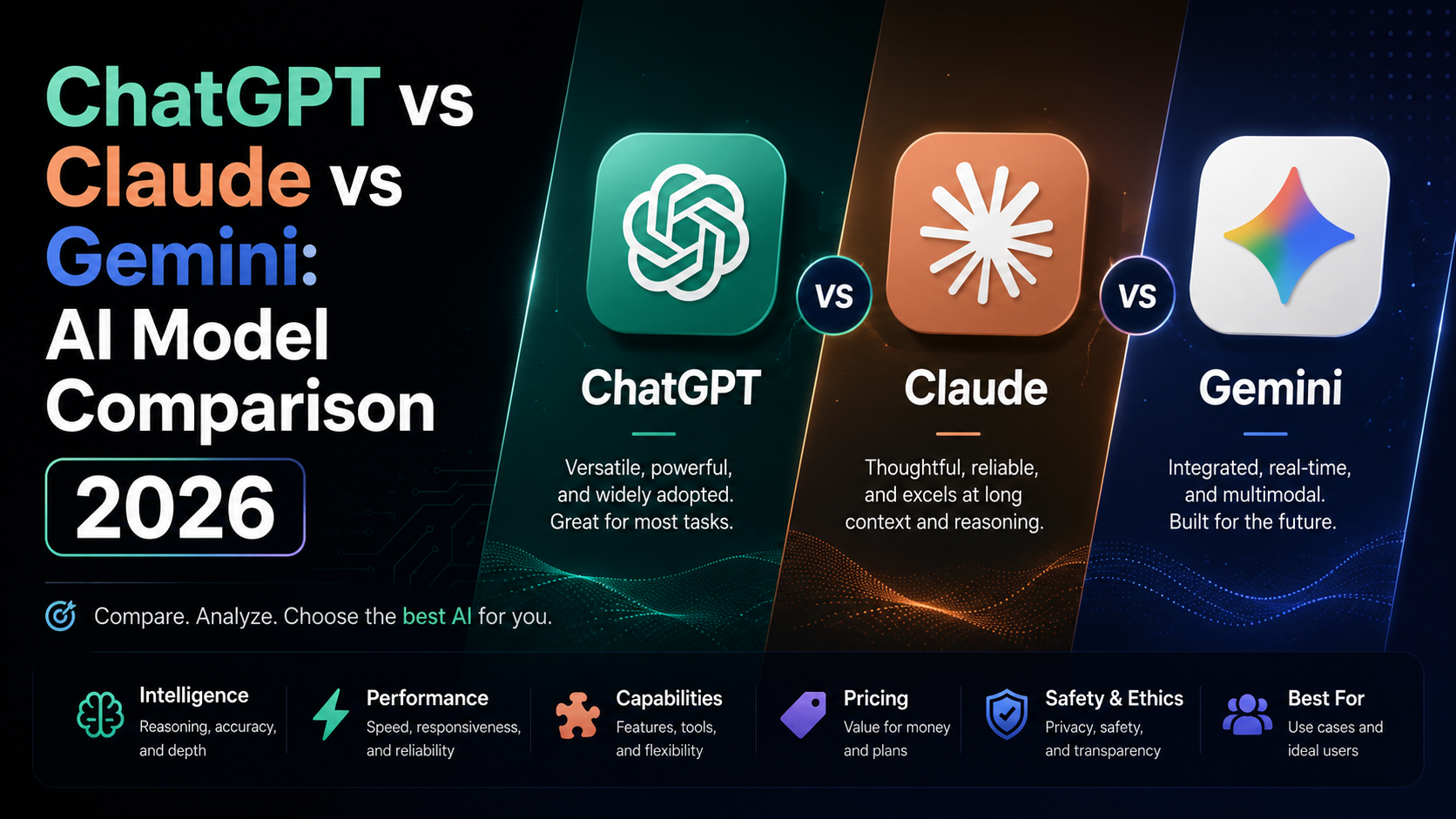
ChatGPT vs. Claude vs. Gemini: 2026 Updates, Pricing & Coding Compared
If it feels like every AI model got a major upgrade in the last month, that’s because they did. Anthropic shipped four new Claude models between June and July, including Claude Opus 5. Google just released Gemini 3.6 Flash alongside two other variants. OpenAI’s GPT-5.6 family reached general availability in early July. All three labs are now racing on the same two fronts at once: raw capability, and — increasingly — how much of that capability you can actually afford to run at real volume.

That makes this a genuinely useful moment to stop and compare all three platforms side by side. Whether you’re picking a subscription, choosing an API for a coding project, or just deciding where to send your next research question, here’s how ChatGPT, Claude, and Gemini actually stack up in July 2026 — updates, pricing, coding performance, and the tools that come bundled with each.
The Latest Model From Each Company
OpenAI — GPT-5.6 (Sol, Terra, Luna). OpenAI’s GPT-5.6 family reached general availability on July 9, 2026, split into three tiers: Sol as the flagship, with Terra and Luna as lighter, cheaper variants. Sol Ultra introduced cooperative subagents — multiple agent instances working different parts of a task in parallel — plus a Cerebras-hardware fast mode for latency-sensitive work. Codex, OpenAI’s dedicated coding agent, runs on Sol Ultra by default.
Anthropic — Claude Opus 5 (and Sonnet 5). Anthropic’s most recent release, Claude Opus 5, launched July 24, 2026, positioned as a model that approaches the intelligence of Anthropic’s top-tier Fable 5 at half the price. It introduced an effort toggle (low/medium/high) for balancing cost against capability, plus far fewer safety-classifier interventions than prior models. It followed Claude Sonnet 5, released a month earlier and built specifically for long agentic coding sessions.
Google — Gemini 3.6 Flash. Google released Gemini 3.6 Flash on July 21, 2026, alongside Gemini 3.5 Flash-Lite and a narrow, security-focused Gemini 3.5 Flash Cyber variant. Gemini 3.6 Flash cut output pricing by 17% compared to its predecessor while using roughly 17% fewer output tokens to complete the same tasks, and it pushed its knowledge cutoff forward to March 2026. Notably, Google’s next-tier model, Gemini 3.5 Pro, remains in partner testing and hasn’t reached general availability yet — Google chose to ship its cheaper, faster tier first.
Pricing: Who’s Actually Cheapest?
Pricing has become the real battleground in 2026, and the numbers move fast enough that it’s worth checking the current rate before committing budget to any one platform. Here’s where things stand as of late July 2026:
| Model | Input (per 1M tokens) | Output (per 1M tokens) | Context Window |
|---|---|---|---|
| GPT-5.6 Sol (OpenAI) | $5 | $30 | Up to 1M (API) |
| Claude Opus 5 (Anthropic) | $5 | $25 | 1M |
| Claude Sonnet 5 (Anthropic, intro pricing) | $2 | $10 | 1M |
| Gemini 3.6 Flash (Google) | $1.50 | $7.50 | 1M |
| Gemini 3.1 Pro (Google) | $2 | $12 | 1M |
On raw per-token pricing, Google currently holds a clear lead — Gemini 3.6 Flash is meaningfully cheaper on both input and output than any comparable-tier model from OpenAI or Anthropic. But per-token price alone doesn’t tell the whole story: a model that needs more tokens or more retries to finish the same task can end up costing more in practice despite a lower sticker price. Anthropic’s Opus 5 is a good example of the opposite effect — its effort toggle lets teams deliberately trade capability for a lower effective cost on routine tasks, without switching models at all.
On the consumer subscription side, the three companies have converged on remarkably similar pricing: OpenAI’s ChatGPT Plus is $20/month, Google’s AI Pro is $19.99/month, and Anthropic doesn’t currently offer a directly comparable mid-tier consumer plan, sitting instead between Claude Pro and the pricier Claude Max, which now defaults to Opus 5.
Coding Performance: The Category Everyone’s Fighting Over
Coding has become the single most closely watched benchmark category in 2026, since it’s the clearest proxy for how well a model can work independently on real, multi-step tasks rather than just answering a single question well.
On Anthropic’s self-reported Frontier-Bench v0.1, an agentic terminal coding benchmark, Claude Opus 5 scores 43.3%, ahead of both Claude Fable 5 (33.7%) and GPT-5.6 Sol (34.4%). On the harder SWE-bench Pro evaluation, the picture flips slightly — Opus 5 scores 79.2%, edged out by Fable 5 (80.0%) and Mythos 5 (80.3%), Anthropic’s restricted-access model. GPT-5.6 Sol, meanwhile, leads on certain agentic coding evaluations like DeepSWE, where it posts 72.7% against Opus 5’s 68.8%.
Gemini’s coding story looks different because Google shipped its cheaper Flash tier first rather than a flagship. Gemini 3.6 Flash still posts real gains over its predecessor — 49% on DeepSWE versus 37% for Gemini 3.5 Flash, and 58.7% versus 55.1% on SWE-Bench Pro — but it’s competing in a different weight class than Opus 5 or GPT-5.6 Sol, and Google’s actual flagship, Gemini 3.5 Pro, hasn’t shipped publicly yet.
The honest summary: for the single hardest coding tasks, Fable 5 and Mythos 5 currently sit at the top, narrowly ahead of GPT-5.6 Sol and Opus 5. For everyday coding work at a reasonable cost, Opus 5 and GPT-5.6 Sol are both strong general-purpose choices, while Gemini 3.6 Flash is the best option if cost efficiency matters more than squeezing out the last few benchmark points.
Tools and Features: What Each Platform Actually Bundles
Beyond the raw model, the surrounding toolset is often what decides which platform fits a given workflow best.
ChatGPT’s ecosystem leans toward breadth. Codex handles dedicated coding work, Agent Mode executes multi-step tasks with tool access, Deep Research produces structured, sourced reports, and a large library of community-built custom GPTs covers everything from proposal writing to niche technical assistants. ChatGPT also offers a unique desktop automation feature that can operate other applications directly.
Claude’s ecosystem centers on long, reliable agentic sessions. Claude Code integrates directly with a project’s CLAUDE.md file, letting teams define coding conventions the agent follows automatically across sessions. Claude Cowork extends this to broader knowledge work beyond just code. Anthropic’s newer models also emphasize self-verification — checking their own output for errors before finishing a task — which reduces the need for constant human correction mid-task.
Gemini’s ecosystem is defined by its integration into Google’s existing products. Gemini is built directly into Gmail, Docs, Sheets, Drive, and Meet, and it processes video and audio natively without needing separate tools. It also grounds answers in live Google Search results with inline citations, which is a genuine advantage for anything requiring current, sourced information. For coding specifically, Google’s Jules agent and the Gemini-powered Antigravity IDE round out the developer-facing side of the ecosystem.
Which One Should You Actually Use?
There’s no universal winner — the right platform depends heavily on what you’re actually doing:
- General writing, brainstorming, and business tasks: ChatGPT remains the most polished all-around option, particularly with its custom GPT library for niche use cases.
- Long, complex coding projects: Claude, especially Claude Code with Sonnet 5 or Opus 5, for its strength in holding context across long agentic sessions without losing track of a project’s conventions.
- Cost-sensitive, high-volume workloads: Gemini 3.6 Flash, for the lowest per-token pricing among the three while still posting real benchmark gains over its predecessor.
- Research requiring current, sourced information: Gemini, for native Google Search grounding, or ChatGPT’s Deep Research for more structured, polished final reports.
- Teams already inside Google Workspace: Gemini, simply for the friction-free integration across Gmail, Docs, and Sheets.
- Enterprise workloads needing strict data controls: Claude, given Anthropic’s no-data-retention policy on its Opus-tier models for general access.
A growing number of power users and small teams in 2026 aren’t picking just one — they’re running two or three subscriptions in parallel, using each platform for what it does best. If budget allows, that combined approach still tends to cost less than a single enterprise-tier plan from any one provider, and it avoids being locked into one lab’s roadmap as pricing and benchmark leadership continue to shift roughly every few weeks.
A Timeline of What Just Happened
The pace of releases in mid-2026 has been unusual even by AI industry standards. Here’s the sequence of major moves from all three companies over the past two months, which helps explain why comparisons written even a few weeks ago are already outdated:
- June 9, 2026: Anthropic releases Claude Fable 5 and the restricted Claude Mythos 5.
- June 30, 2026: Anthropic releases Claude Sonnet 5, its most agentic Sonnet-tier model to date.
- July 9, 2026: OpenAI’s GPT-5.6 family (Sol, Terra, Luna) reaches general availability, with Codex moving to Sol Ultra.
- July 16, 2026: Moonshot AI releases Kimi K3, an open-weight model that briefly tops several coding benchmarks, adding pressure on all three major labs.
- July 21, 2026: Google releases Gemini 3.6 Flash, Gemini 3.5 Flash-Lite, and the narrow Gemini 3.5 Flash Cyber variant.
- July 24, 2026: Anthropic releases Claude Opus 5, its fourth new model in under two months.
That’s six major model releases across three companies in roughly seven weeks. Part of what’s driving this cadence is competitive pressure from open-weight labs in China, part of it is each company racing to claim the best cost-to-performance ratio before a rival does, and part of it is simply that training and evaluation cycles have compressed enough that shipping every few weeks is now operationally possible in a way it wasn’t in 2024 or 2025.
Multimodal and Research Capabilities
Coding tends to dominate the benchmark conversation, but plenty of real-world work depends on how well a model handles images, audio, video, and research grounded in current information — and here the three platforms genuinely diverge.
Gemini’s biggest structural advantage remains native multimodal processing: it handles video and audio directly without bolting on separate tools, and it consistently leads multimodal reasoning benchmarks. Combined with live Google Search grounding and inline citations, it’s the strongest option among the three for research-heavy work that touches current events or needs source verification built into the answer itself.
ChatGPT has closed part of that gap with improved image generation and general multimodal support, and its Deep Research feature produces well-organized, structured reports that many users find easier to act on than a raw list of grounded search results. Claude remains comparatively text-focused — its strength lies less in multimodal breadth and more in how reliably it reasons through long, complex written or coding tasks without losing the thread.
Enterprise Use and Data Privacy
For businesses evaluating these platforms beyond individual use, data handling policies differ in ways that matter for compliance-sensitive work. Anthropic’s Opus-tier models, including Opus 5, carry no data retention requirement for general access by default — a detail the company specifically calls out for enterprise customers with strict zero-data-retention policies. OpenAI and Google both offer similar opt-out controls on paid and enterprise tiers, though the defaults and documentation differ across consumer versus business accounts.
Google’s enterprise offering benefits from being built on the same infrastructure as the rest of Google Workspace, meaning the same data governance and sovereignty controls already familiar to Workspace administrators extend to Gemini use inside those tools. OpenAI’s enterprise tier offers comparable controls along with a temporary chat mode that doesn’t retain conversation history at all, useful for one-off sensitive queries outside a formal enterprise contract.
The practical takeaway for any business choosing between these platforms: don’t assume default settings are safe for confidential material. Check the specific data-retention and training-opt-out policy for whichever plan you’re actually paying for, since consumer and enterprise tiers within the same company can differ significantly.
Frequently Asked Questions
Which AI model is best overall in 2026? There’s no single best model across every category. Anthropic’s Fable 5 and Mythos 5 currently lead on the hardest coding benchmarks, Claude Opus 5 and GPT-5.6 Sol offer the strongest everyday performance-to-cost ratio, and Gemini 3.6 Flash leads on affordability. The right choice depends on the specific task.
Which is cheapest: ChatGPT, Claude, or Gemini? On raw API pricing, Gemini 3.6 Flash is currently the cheapest of the three per token. On consumer subscriptions, ChatGPT Plus and Google AI Pro are priced almost identically at roughly $20/month.
Which AI is best for coding right now? For the hardest, most complex coding tasks, Anthropic’s Fable 5 and Mythos 5 currently lead, with GPT-5.6 Sol and Claude Opus 5 close behind for everyday coding work. Gemini’s coding-specific flagship, Gemini 3.5 Pro, hasn’t reached general availability yet.
Do I need to pick just one of these platforms? No. Many users and small teams run two platforms side by side — often ChatGPT or Claude for daily work alongside Gemini for research or Workspace-integrated tasks — since the combined cost is often still lower than a single top-tier enterprise plan.
How often do these models actually change? Very often in 2026. All three labs have shipped major updates within weeks of each other for most of this year, so pricing and benchmark leadership shift regularly. It’s worth rechecking current numbers before making a purchasing decision rather than relying on older comparisons.
Is Gemini’s free tier good enough for regular use? Yes, for light to moderate use. Google offers a genuinely usable free tier through the Gemini app, and Google AI Studio provides free API access with daily request limits — enough for most individual users, though heavier or business use will hit those caps quickly.
Which platform is easiest to switch to if I’m currently locked into one? All three now support broadly similar workflows — chat, coding assistance, research, and file handling — so switching costs are lower than they were a year ago. The bigger friction point is usually rebuilding custom automations or saved prompts tied to a specific platform’s features, like ChatGPT’s custom GPTs or Claude Code’s CLAUDE.md conventions, rather than the core model itself.
The Bottom Line
The gap between ChatGPT, Claude, and Gemini has narrowed to the point where the “best” model genuinely depends on the task rather than one platform being clearly ahead across the board. OpenAI holds an edge in ecosystem breadth and custom tooling, Anthropic leads in long-session coding reliability and enterprise data controls, and Google currently wins on raw cost efficiency while its true flagship model is still cooking. Given how quickly all three labs are shipping updates — often within weeks of each other — the smartest approach for most people isn’t picking a permanent favorite. It’s matching the tool to the task, and checking back in a month, because by then, at least one of these three will likely have shipped something new again.