



























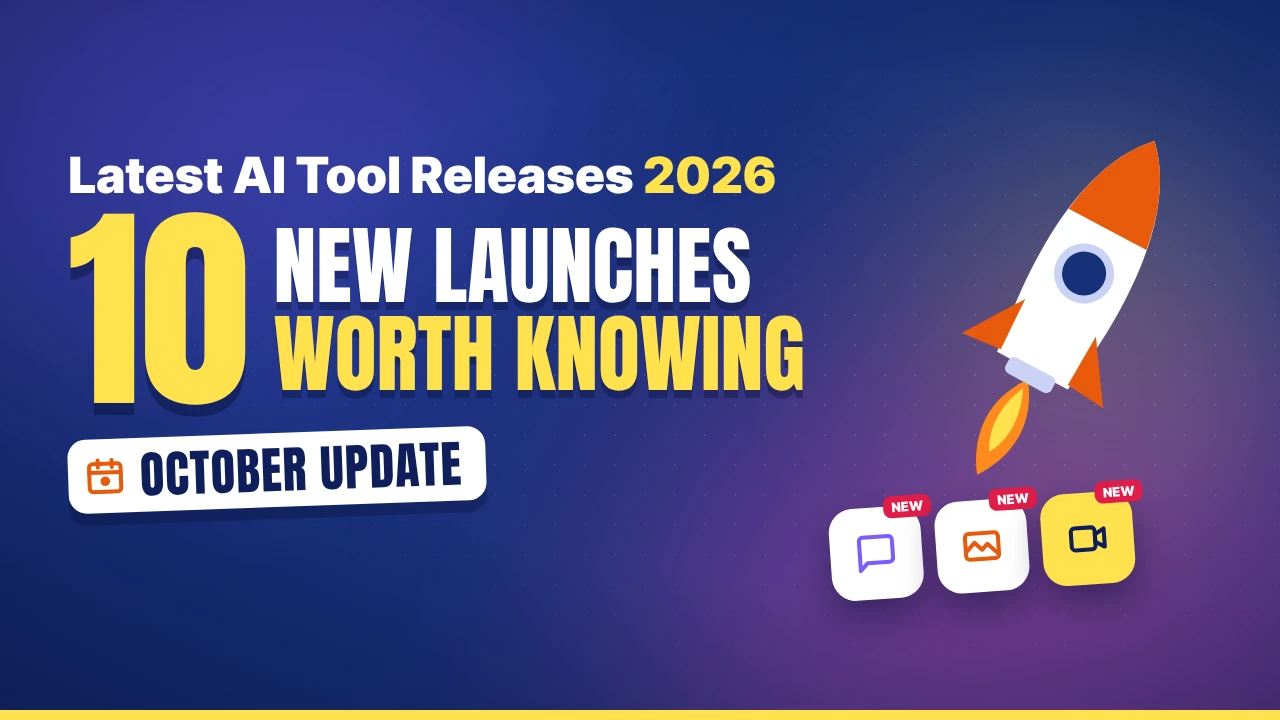
Latest AI Tool Releases in 2026: 10 New Launches Worth Knowing (October Update)
Disclosure: this article was drafted with Claude, which is made by Anthropic. Two of the ten entries below are Anthropic products. I used the same standard for every entry: dates and details from official pages where they loaded, and clear labels where I had to rely on news reports or could not confirm something.
New AI releases arrive faster than anyone can test them. This roundup focuses on launches from roughly September to October 24, 2026 that ordinary users, creators, and developers can actually try or plan around. For each one you get the date, what it does, who can use it, and what to check before you commit.
Plans, prices, and availability change fast, so confirm before you pay. Where a vendor’s own page did not load, I say so.
The Releases at a Glance
| # | Release | Date | Who it is for | Access |
|---|---|---|---|---|
| 1 | Claude Duet | Oct 21–22 | Busy professionals | US Pro and Max, waitlist |
| 2 | Claude Haiku 5.5 (with Opus 5.5 and Sonnet 5.5) | Sep 22–Oct 7 | Developers, high-volume tasks | API and cloud platforms |
| 3 | Gemini 4 Argon | Mid-October | Gemini users, developers | Google AI Pro and Ultra in the app |
| 4 | Canva Craft | Oct 22 | Designers, small business | All Canva users, via Dream Lab |
| 5 | Meta Muse | Sep 8 | Everyday shoppers | US, free and paid tiers |
| 6 | OpenAI Decisions API | Oct 6 | Developers | Public beta |
| 7 | ChatGPT Locked Chats | Oct 20 | Privacy-minded ChatGPT users | Gradual rollout |
| 8 | Nvidia DGX Spark 64GB | Oct 23 | Local-AI enthusiasts | Via hardware partners |
| 9 | Recursive Flint | Oct 21 | Coders, local-model fans | Open weights, Apache 2.0 |
| 10 | 1Password agent logins | July (expanded since) | Agent users | Mac, Claude |
1. Claude Duet
Anthropic’s Duet is a personal agent that sends a morning briefing, works in the background, and asks for approval before sending messages, making payments, signing documents, or deleting anything. Anthropic’s page describes it as a research preview available only in the US, to Claude Pro and Max subscribers, through a waitlist. It uses your plan’s existing usage limits, and no separate price is listed. For the full breakdown, see our explainer on Claude Duet.
Check before you join: whether you are in the US, on Pro or Max, and comfortable connecting your accounts.
2. Claude Haiku 5.5, plus Opus 5.5 and Sonnet 5.5
Anthropic’s news page lists Opus 5.5 on September 22, Sonnet 5.5 on September 28, and Haiku 5.5 on October 7. Haiku 5.5 is the small, fast model, aimed at high-volume, cost-sensitive work such as summaries, classification, and database queries, and at acting as a subagent next to the larger models. Anthropic lists API pricing of $0.10 per million input tokens and $0.50 per million output tokens for prompts up to 100,000 tokens, and says it is the first Haiku-class model with an adjustable effort setting. The page does not say whether free plans include it.
Anthropic also says Sonnet 5.5 and Opus 5.5 remain better for complex agentic coding. The benchmark figures on the page are Anthropic’s own, so test with your own tasks.
Best for: developers building cheap, fast pipelines.
3. Gemini 4 Argon
Google’s AI blog lists “Gemini 4 is now available in the Gemini app” and “Gemini 4 Argon is now available for developers.” A recap dated October 14 says Google AI Pro and Ultra subscribers can access Gemini 4 Argon, describing frontier reasoning and agentic coding. I could not open Google’s own post for details, so I cannot confirm limits, free-plan access, or developer pricing. Check the Google AI blog and your Gemini plan page.
Check before you pay: which plan includes it and what usage limits apply.
4. Canva Craft
Canva’s first in-house image model launched on October 22 and is available to all Canva users through Dream Lab. Canva says it is built for design: strong text rendering in 55 languages, images up to 2K in more than 30 aspect ratios, and targeted edits. The ranking claims come from Canva. What its pages do not say is how Craft counts against the free allowance, which is up to 20 uses of Standard or Premium AI tools combined. Our guide on using Canva’s AI image generator has the steps and the gaps.
Best for: posters, social posts, and text-heavy graphics.
5. Meta Muse
Muse is Meta’s personal AI agent. According to The Next Web, relaying an Axios report, Meta announced it on September 8 and rolled it out in the United States on iOS, Android, and the web. It can read email, book travel, fill in forms, negotiate, and pay with your card through Stripe’s Link, and it keeps working after you close the app. Reported pricing is a free tier plus $20 and $100 monthly subscriptions. Meta says there is no advertising in the product and that conversations are kept away from ad systems, but the report notes that, until a confidential version arrives, this is a policy commitment rather than a technical guarantee.
A newsletter citing Meta’s earnings call says Muse reached more than 10 million users in the US and Canada, with shopping the top use. The launch report mentions only the US, so treat the Canada detail as unconfirmed. Our piece on how AI recommendations change what people buy covers the shopping side.
Check before you trust it with payments: the approval steps, and the fact that agents can make purchases quickly, including wrong ones.
6. OpenAI Decisions API
This is a developer tool. Dealroom reports that OpenAI opened a public beta on October 6, running on GPT-6 Luna through a dedicated endpoint. Instead of writing text, it answers fixed questions with a probability, a choice, or a score, for tasks like routing and classification. OpenAI claims it is up to 10 times faster than calling the same model through its standard interface, and lists $0.10 per million input tokens. A competitor, TypeSafe’s Jev, is listed at a lower price, and an informal developer comparison reported it faster and more accurate on some questions. That test is early and unverified. A TechCrunch headline on October 22 says OpenAI has now made the product widely available.
Best for: developers who need fast, cheap classification. I did not open OpenAI’s own announcement.
7. ChatGPT Locked Chats
OpenAI’s release notes describe an October 20 feature that moves selected conversations out of your regular history, pinned chats, and search, behind a 4-digit PIN or supported device authentication, rolling out gradually to Free, Go, Plus, and Pro users. Memory behavior is not covered in the notes, and news reports differ on details, such as what a PIN reset deletes. See our guide to how Locked Chats work.
Check before you rely on it: it is not end-to-end encryption, and retention settings are unchanged.
8. Nvidia DGX Spark 64GB
HotHardware reports that the 64GB version, sold through hardware partners, is due October 23, with one example at $4,999 (the Dell Pro Max with GB10), while the 128GB model now costs $6,995. It has half the memory but keeps features such as 200 Gbps networking. The article says models around 80 billion parameters and above are the main loss, and links the cut to rising memory prices. It does not say that pairing two units is officially supported, though another outlet suggests it is possible. Check Nvidia’s own page for current specs.
Best for: people who want serious local AI at home or in a small team. Our beginner guide to running AI offline with LM Studio is a much cheaper place to start.
9. Recursive Flint
Flint is an open coding model released October 21. LM Studio’s model page lists 39.8 billion total parameters with about 2.5 billion active per token, a 262,144-token context window, a GGUF download of 24.20 GB, a minimum of 24 GB of system RAM, and an Apache 2.0 license. Headlines say it was built largely by AI, which is Recursive’s claim. One news summary cites a score of 89.7% on a coding benchmark, which I could not verify.
Best for: developers who want a local coding model and have enough memory.
10. 1Password agent logins
1Password’s July 17 launch lets Claude sign in to websites without the model seeing your passwords. According to The New Stack, credentials are decrypted on your Mac and injected into the site, you approve each session with biometrics, and access expires when the task ends. It supported only Claude at launch, on Mac, and the article notes prompt injection remains a risk after an agent signs in. A TechCrunch headline on October 22 describes a newer launch for AI agents more broadly, and a newsletter lists Meta’s Muse among supported agents. I could not open those details, so confirm what is supported today.
Best for: people using agents that need logins, if they are comfortable with the approval model.
Releases to Watch, Unverified
These appeared in news summaries on October 23 but I could not confirm them from official pages:
- Kimi K3.1 Pro (Moonshot): reported 1M-token context, with open weights planned for November 4.
- HeyGen Video 1: reported as ranked first for text-to-video in a blind test.
- Ideogram’s vector model: reported to generate scalable SVG graphics from text.
- Claude auto mode: reported as becoming the default for Pro, Max, and Team users next week. Anthropic’s news page did not list it.
How to Choose What to Try
- Start with the problem. A new model matters only if it solves something you do.
- Check the plan. Many launches start with paid tiers, waitlists, or one country.
- Test on your own work. Vendor benchmarks are the vendor’s.
- Mind the data. Agents that touch email or payments need careful permissions.
- Wait for the second week. Early reports often get corrected.
Common Mistakes to Avoid
Treating headlines as availability. “Launched” can mean waitlist, beta, or one region.
Trusting benchmark tables. They come from the maker.
Connecting everything on day one. Add accounts to agents slowly.
Buying hardware for a model you have not tried. Test models in software first.
Ignoring costs after the free trial. Check what each tier includes.
Missing the date. In this field, a post from last month can already be out of date.
Frequently Asked Questions
What is the most important AI release this month? It depends on your use. For consumers, Canva Craft and ChatGPT Locked Chats are the easiest to try. For developers, Claude Haiku 5.5, the Decisions API, and Flint are the most relevant.
Which of these are free? Canva Craft is available to all Canva users, with a limited free allowance. Locked Chats is rolling out to free ChatGPT users. Muse has a free tier. Check each page for limits.
Which need a paid plan? Claude Duet needs Pro or Max, and Gemini 4 Argon in the app is reported for Google AI Pro and Ultra.
Are the benchmark scores reliable? They are the makers’ own numbers unless an independent source says otherwise.
Where can I verify a release? Start with the vendor’s own news or help page, and treat news summaries as pointers.
The Bottom Line
October’s releases share a theme: agents that act for you, privacy controls for what you tell AI, and cheaper models and hardware you can run yourself. The most useful move is not to try everything, but to pick one or two that fit your work, read the plan and limit details, and test them with real tasks. I will keep the unverified items flagged until official pages confirm them.
Sources
- Anthropic: Claude Duet
- Anthropic: Claude Haiku 5.5 and news page
- Google AI blog
- Canva: Introducing Canva Craft
- The Next Web: Meta launches Muse
- Dealroom: OpenAI opens Decisions API to all developers
- OpenAI: ChatGPT release notes
- HotHardware: Nvidia DGX Spark 64GB
- LM Studio: Recursive Flint
- The New Stack: 1Password agent authentication framework
- TechCrunch: AI category