

5 AI Tools That Help You Prepare for Exams Faster
Exam season doesn’t leave room for inefficient studying. Between multiple subjects, limited time, and the pressure to actually retain what you read, the old method — reading notes over and over and hoping something sticks — just doesn’t hold up anymore. AI tools have changed that equation. The right one can turn a pile of lecture slides into a study plan, or a dense textbook chapter into a quiz you can actually test yourself on.

Here are 5 AI tools that genuinely help students prepare for exams faster in 2026 — not just flashy demos, but tools that save real study time.
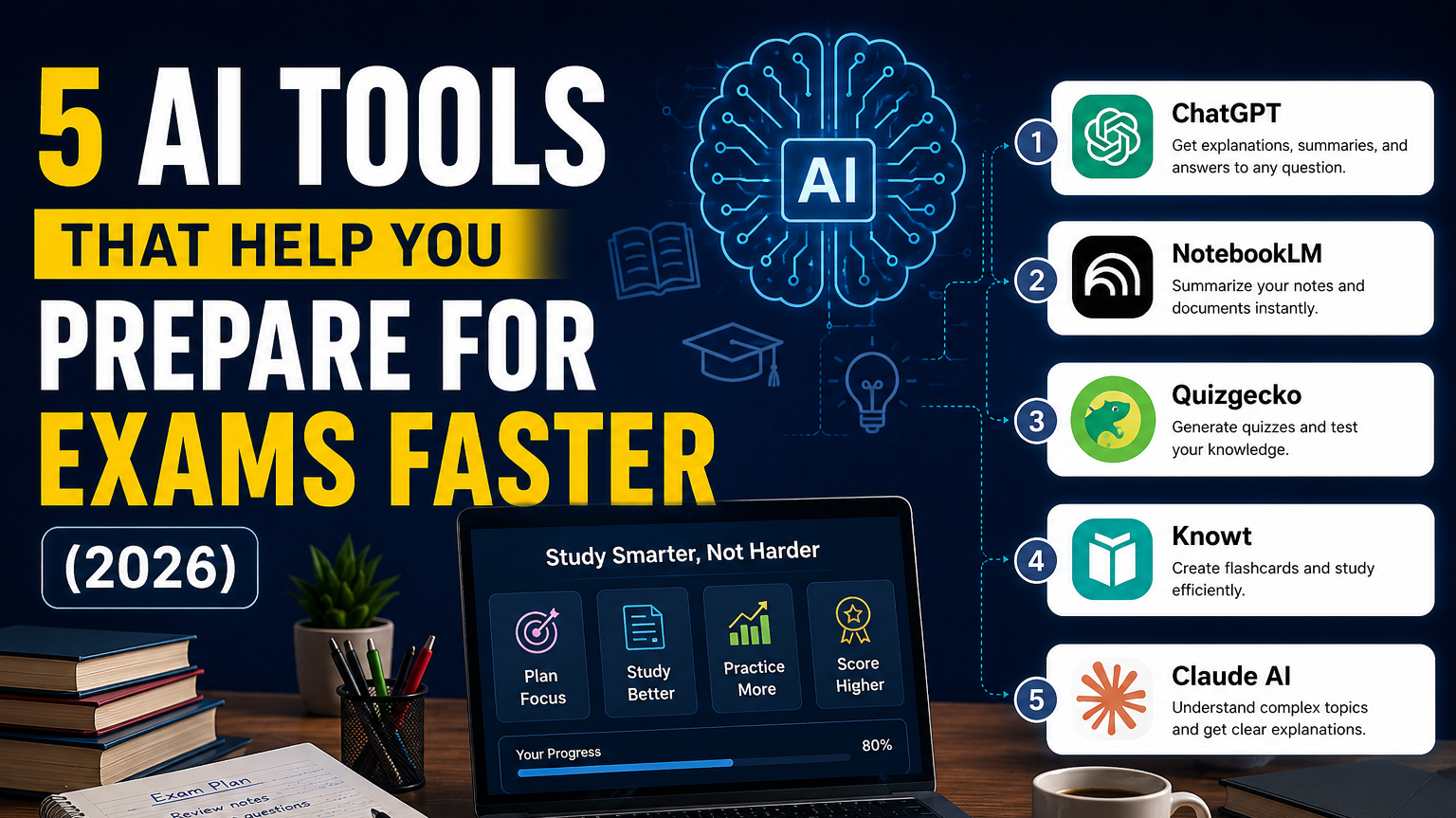
1. ChatGPT — Best All-Around Study Assistant
Best for: explaining difficult concepts, generating practice questions, and essay planning
ChatGPT remains the most versatile AI study tool available, and it earns that reputation honestly. Paste in a confusing paragraph from your textbook and ask it to explain the idea “like I’m 16,” and it will break the concept down into something you can actually follow. It’s just as useful the other way around — feed it your syllabus or a topic list and ask it to generate mock exam questions in the same style your class will actually test you on.
For essay-based subjects, ChatGPT can help structure an outline, suggest counterarguments you hadn’t considered, or turn a rough set of bullet points into a coherent draft you can revise yourself. It works for nearly any subject, which makes it the natural starting point before you bring in more specialized tools.
Keep in mind: ChatGPT can occasionally generate inaccurate information, especially on very specific facts, dates, or niche topics. Always double-check anything you plan to write down as fact before it goes into an actual answer sheet.
2. Google NotebookLM — Best for Studying From Your Own Material
Best for: turning your own lecture notes, slides, and textbook PDFs into a personal study assistant
NotebookLM works differently from a general chatbot: it only answers based on documents you actually upload — lecture notes, textbook chapters, past papers, or your own handwritten notes scanned in. That constraint turns out to be the entire point. Because it’s limited to your material, it can’t invent details about your specific course the way a general-purpose AI sometimes does.
Upload everything from a single unit before a test, then ask it to summarize the key themes, compare two related concepts, or generate a set of likely exam questions based only on what you gave it. It’s especially useful in the final days before an exam, when you need to consolidate a semester’s worth of scattered notes into something reviewable in one sitting. It also includes an audio overview feature that turns your material into a spoken, podcast-style summary — a genuinely useful option if you retain information better by listening than by reading.
3. Quizgecko — Best for Turning Notes Into Instant Practice Tests
Best for: generating practice tests directly from your existing study material
Quizgecko takes a block of text, a PDF, a URL, or even a YouTube video and turns it into a set of practice questions that closely resemble real exam formatting — multiple choice, short answer, or full written responses, depending on what you need. Instead of manually writing your own practice questions (which takes time you don’t have during exam week), you paste in your material and get a usable test in seconds.
This matters more than it sounds. Active recall — actually testing yourself on material rather than passively re-reading it — is one of the most well-supported study techniques there is, but it’s also the one students skip most often because writing good practice questions is tedious. A tool that automates that step removes the main excuse to skip it.
4. Knowt — Best for Flashcards and Spaced Repetition
Best for: memorization-heavy subjects like vocabulary, biology terms, or historical dates
Paste your notes into Knowt and it generates flashcards and short quizzes in roughly the time it takes to make a coffee. What sets it apart from a plain flashcard app is the built-in spaced repetition system: cards you consistently get wrong are shown to you more often, while cards you’ve clearly mastered fade into the background. That means your review time goes toward the material you actually don’t know yet, instead of re-covering concepts you already have down.
This is the strongest option on this list specifically for subjects that come down to raw memorization — language vocabulary, anatomical terms, chemical formulas, historical dates — where the challenge isn’t understanding but recall under pressure.
5. Claude AI — Best for Long-Answer and Theory-Based Subjects
Best for: essay structure, long-form theoretical answers, and subjects where explanation quality matters
For exams that reward clear, well-structured written answers rather than short factual recall, Claude AI is worth having in your toolkit alongside a more general tool. It tends to produce logically organized, clearly reasoned responses — useful as a model for how to structure your own long-answer responses in subjects like literature, philosophy, law, or the social sciences, where presentation and argument quality are graded alongside content.
Rather than copying its answers directly (which won’t teach you anything and won’t match your own understanding under exam pressure), use it to see how a complex answer can be organized: introduction, structured argument, supporting evidence, conclusion. Practicing writing your own answer and comparing it against a well-structured model is a much stronger use of the tool than outsourcing the writing entirely.
How to Actually Use These Tools Without Wasting Time
Having five tools open at once isn’t a study strategy — it’s a distraction. A more realistic approach looks like this:
- Early in your revision period: Use NotebookLM to consolidate scattered notes and slides into one organized source, and use ChatGPT to get plain-language explanations of anything that isn’t clicking.
- Mid-revision: Convert your consolidated notes into flashcards with Knowt for memorization-heavy content, and generate practice tests with Quizgecko for anything that needs active recall practice.
- Final days before the exam: Use Claude AI to practice structuring long-form answers if your exam involves essays, and use ChatGPT to run through a final round of mock questions under time pressure.
A Few Honest Warnings
AI study tools genuinely save time, but they come with real limits worth knowing before exam day:
- Hallucinations happen. Any general-purpose AI chatbot can occasionally state something confidently that’s simply wrong. Cross-check anything specific — dates, formulas, quotes, statistics — against your actual course material before you memorize it.
- They can’t replace understanding. A tool that generates a perfect practice question for you doesn’t guarantee you understand the underlying concept. Answer the question yourself first, then check your reasoning — don’t just read the AI’s explanation and assume it stuck.
- Match the tool to the exam format. A tool built for flashcard memorization won’t help much with a long-form essay exam, and vice versa. Picking the tool that matches how you’ll actually be tested matters more than picking the most popular one.
Quick Comparison Table
| Tool | Best For | Free Plan? | Ideal Exam Type |
|---|---|---|---|
| ChatGPT | General explanations & practice questions | Yes | Any subject |
| NotebookLM | Studying from your own notes/PDFs | Yes | Any, especially content-heavy courses |
| Quizgecko | Instant practice tests from notes | Limited free tier | Multiple-choice & short-answer exams |
| Knowt | Flashcards with spaced repetition | Yes | Vocabulary, terminology, memorization |
| Claude AI | Long-form, structured answers | Yes (with limits) | Essay-based & theory exams |
Frequently Asked Questions
Can AI tools actually improve exam grades, or are they just a convenience? Used correctly, they do more than save time — tools like Quizgecko and Knowt encourage active recall, which is one of the most effective study techniques backed by learning research. The grade improvement comes from that behavior change, not from the AI itself doing the thinking for you.
Is it cheating to use AI tools to prepare for exams? No, as long as you’re using them to study rather than to generate answers you submit as your own during the actual exam. Using ChatGPT to explain a concept or Knowt to build flashcards is no different from using a tutor or a study guide — the exam itself still tests what you’ve actually learned.
Which AI tool is best for last-minute cramming? NotebookLM for consolidating scattered notes fast, combined with Quizgecko to generate a practice test from that consolidated material. Together they can turn a night-before panic into a structured, if compressed, review session.
Do I need to pay for these tools to get real value? No. Every tool on this list offers a usable free tier. Paid upgrades typically remove usage caps or add advanced features, but the free versions are enough to build an effective study routine, especially if you’re only using one or two tools at a time.
What’s the biggest mistake students make when using AI to study? Passively reading AI-generated explanations instead of testing themselves. Reading an explanation feels like learning, but it doesn’t build the retrieval skill you’ll actually need in the exam room. Always follow an explanation with a self-test — a flashcard, a practice question, or writing the answer from memory.
The Bottom Line
None of these tools are magic — they don’t replace the actual work of understanding your material. What they do is remove the tedious, time-consuming parts of studying: writing your own practice questions, making flashcards by hand, or organizing scattered notes into something reviewable. Used well, that’s real time back in your schedule, whether that means more sleep before the exam or more time on the one subject you’re genuinely struggling with. Pick one or two from this list that match your exam format, and let them handle the busywork so you can focus on actually learning the material.