























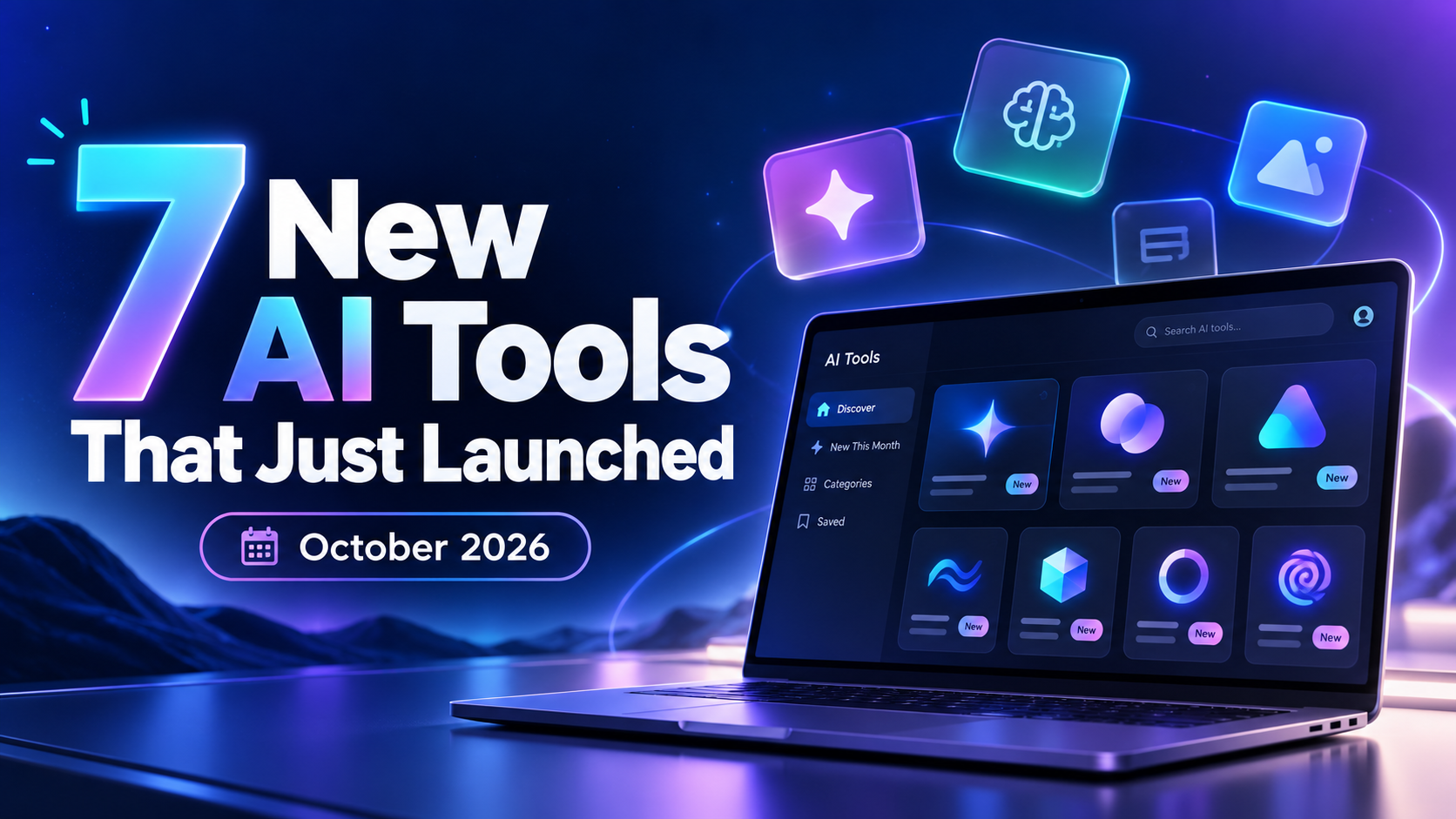
7 New AI Tools That Just Launched (October 2026): What They Do and Who They’re For
The first two weeks of October 2026 were crowded. Between the big model announcements, a wave of smaller, more specific tools quietly shipped — products that solve a narrow problem rather than try to be a do-everything chatbot. Some are free, some are experimental, and a few are limited to certain countries, which matters if you plan to try them.
Here are seven new AI tools worth knowing about as of October 12, 2026, with what each one does, what it costs or requires, and who actually benefits. If you want the earlier batch, see our roundup of new AI tools from June and July.
1. Google Playground — Build Browser Games by Describing Them
Launched: October 7, 2026 (Google Labs)
Playground lets you create, play, and share browser games using nothing but text prompts. You can start from a blank canvas, remix a starter prompt, or let a guided mode lead you, then describe the genre, visual style, and mechanics. You choose whether the game is 2D or 3D and single-player or multiplayer, and you can upload your own artwork for the AI to convert into game assets that match the game’s style. Behind the scenes, Google combines Gemini for game logic, Nano Banana for visuals, and Lyria for music.
What it costs: playing games is free. Creating them runs on a weekly token system, with a limited free allowance and higher limits for Google One AI subscribers.
Catch: at launch it’s open to adults aged 18 and over in the US only, and Google labels it an early experiment. A Unity Spark integration for more advanced 3D mechanics is planned but still in closed beta.
Who it’s for: hobbyists, students, and creators who want to prototype a game idea without learning a game engine.
2. SynthID Detector — A Free Way to Check for AI Watermarks
Launched: opened to the public the same week (Google)
Google made its SynthID verification site available to everyone, letting anyone check whether an image, video, or audio clip carries Google’s AI watermark. SynthID marks media created with Google tools such as Nano Banana, Veo, Lyria, Gemini, and Flow, and other companies including OpenAI, Nvidia, and Kakao support the technology. Verification is also built into the Gemini app and Chrome, and Google says it already handles around a million verification requests a day.
What it costs: free.
Catch: it detects SynthID watermarks, so a clean result doesn’t prove something wasn’t AI-generated — content from tools that don’t use the watermark won’t be flagged. Treat a positive result as strong evidence and a negative one as inconclusive.
Who it’s for: journalists, teachers, moderators, and anyone who wants a quick check on suspicious media.
3. Google AI Edge Foresight — An Offline Meeting Note-Taker
Launched: first week of October 2026 (Google)
Foresight is an experimental Mac app that transcribes meetings, turns your shorthand into fuller notes, and answers questions, all without an internet connection. It uses Google’s on-device Gemma-based models, including the 740-million-parameter EmbeddingGemma 2, so audio and files stay on your Mac rather than going to a cloud server. It shows your own notes next to the AI-generated ones, and you can add PDFs, documents, and bookmarks to build a personal knowledge base to search.
What it costs: free.
Catch: it’s Mac-only, optimized for Apple Silicon, and explicitly experimental, so expect rough edges. It also competes in a crowded field of note-taking apps, and cloud-based rivals may offer deeper integrations with video-call platforms.
Who it’s for: privacy-conscious professionals, journalists, and anyone who takes notes in places without reliable internet.
4. Meta Muse — A Personal AI Agent That Does Tasks
Launched: mobile in early September; iPad app in early October (Meta)
Meta describes Muse as a personal AI agent that can carry out tasks on your behalf rather than just answer questions. It climbed to the top of the App Store’s free rankings after its September launch on iPhone and Android, then gained a Mac version that can work with desktop files, and now a native iPad app. The latest version, Muse 10.0, adds more business-oriented skills alongside the iPad support.
What it costs: the app is free to download.
Catch: an agent that acts for you needs broad access to your data. Meta says it built the service to be safe and private, but the App Store’s privacy label indicates extensive data collection, so read the permissions before connecting accounts or files.
Who it’s for: people curious about agent-style assistants who are comfortable with Meta’s data practices.
5. TikTok Shopping Assistant and Buy Direct — AI Inside the Feed
Launched: announced October 5, 2026 (TikTok)
TikTok introduced a conversational Shopping Assistant that remembers your preferences during a chat and answers questions about product details, shipping, sizing, and availability. Alongside it comes Buy Direct, a one-click checkout that lets people purchase from a brand straight from the For You feed, with saved payment details and in-app order tracking. TikTok says it’s working with partners including Salesforce, Shopify, Shoplazza, and Stripe.
What it costs: free for shoppers. It’s an advertiser and merchant feature.
Catch: reporting describes it as rolling out through limited testing and eligibility, so not every user or seller will see it yet.
Who it’s for: online sellers and marketers. If you create TikTok content, our guide to using AI insights to go viral pairs well with this, since discovery and purchase are moving closer together.
6. Claude Dashboards and Claude Motion — Live Numbers and Animated Explainers
Launched: October 8, 2026 (Anthropic, beta)
Anthropic released two new beta features. Claude Dashboards helps track numbers that update over time, so you don’t have to rebuild a chart every time the data changes. Claude Motion turns reports and ideas into short animated explainers. They arrived alongside the news that Claude Docs, Slides, and Design are now out of beta and available on every plan, including Free.
What it costs: Dashboards is in beta on paid plans, and Motion is in beta on Team and Enterprise. Usage counts against your plan’s shared limits.
Catch: both are beta, and Anthropic hasn’t published a date for them to leave beta. Test any dashboard against a number you can verify before you rely on it.
Who it’s for: analysts, marketers, and teams that report regularly and want less manual chart-making.
7. Kane CLI — A Free Testing Agent for AI-Written Code
Launched: early October 2026 (TestMu AI, formerly LambdaTest)
Kane CLI is a free command-line tool that runs plain-English test instructions in a real Chrome browser and returns structured pass-or-fail results with an evidence pack. It’s designed to act as a verification step for AI coding agents such as Claude Code and to gate software release pipelines using standard exit codes.
What it costs: free, according to its listing.
Catch: this one is for developers, and the details come from a tool directory listing rather than a major launch announcement, so check the vendor’s documentation before building on it.
Who it’s for: developers who let AI agents write code and want an automated check that the result actually works.
Quick Reference
| Tool | Company | Cost | Main limit |
|---|---|---|---|
| Google Playground | Google Labs | Free to play; weekly tokens to create | US adults 18+ only |
| SynthID Detector | Free | Detects SynthID watermarks only | |
| Google AI Edge Foresight | Free | Mac (Apple Silicon), experimental | |
| Meta Muse | Meta | Free app | Broad data access |
| TikTok Shopping Assistant | TikTok | Free for shoppers | Limited testing |
| Claude Dashboards / Motion | Anthropic | Paid plans / Team and Enterprise | Beta |
| Kane CLI | TestMu AI | Free | Developer tool |
What These Launches Have in Common
Look across the seven and three patterns stand out. First, on-device and privacy-first options are growing, with Foresight keeping everything local. Second, agents are moving into everyday apps: Muse acts on your behalf, TikTok’s assistant helps you buy, and Dashboards keeps numbers current. Third, trust tools are catching up, as SynthID Detector and Kane CLI both focus on verifying what AI produced rather than generating more of it.
That last point may be the most important. As AI-generated media and code become routine, checking them is becoming its own category.
How to Try Them Safely
- Start with the free, low-risk ones. SynthID Detector and Foresight ask for little and are easy to test.
- Read permissions before connecting accounts. This applies most to agent-style tools like Muse.
- Treat beta and experimental labels seriously. Don’t build a business process around a feature that can change or disappear.
- Check regional availability. Playground is US-only for now, and TikTok’s features are in limited testing.
Frequently Asked Questions
Which of these new AI tools are free? SynthID Detector, Foresight, Kane CLI, and the Muse app are free to use. Playground is free to play with limited free creation tokens, and Claude’s new features depend on your plan.
Can I use Google Playground outside the US? Not yet. At launch it’s limited to US users aged 18 and over, and Google hasn’t published an international timeline.
Does SynthID Detector catch all AI-generated content? No. It detects content marked with the SynthID watermark, which covers Google’s tools and partners that adopted it. Unmarked AI content won’t be flagged.
Is Meta Muse safe to use? Meta says it was built to be safe, secure, and private, but the App Store’s privacy label lists broad data collection. Review what you grant it access to before connecting sensitive accounts or files.
Which tool is best for creators? Playground for game ideas, Foresight for interviews and meetings, and TikTok’s new commerce features if you sell through short video.
The Bottom Line
October’s new AI tools are less about raw intelligence and more about specific jobs: building a game without code, checking whether media is AI-generated, taking notes offline, shopping inside a feed, or testing code an AI wrote. Most are free or low-cost to try, but several are experimental, region-limited, or still in beta, so test before you depend on them. Expect more launches within weeks — this category moves fast.