






















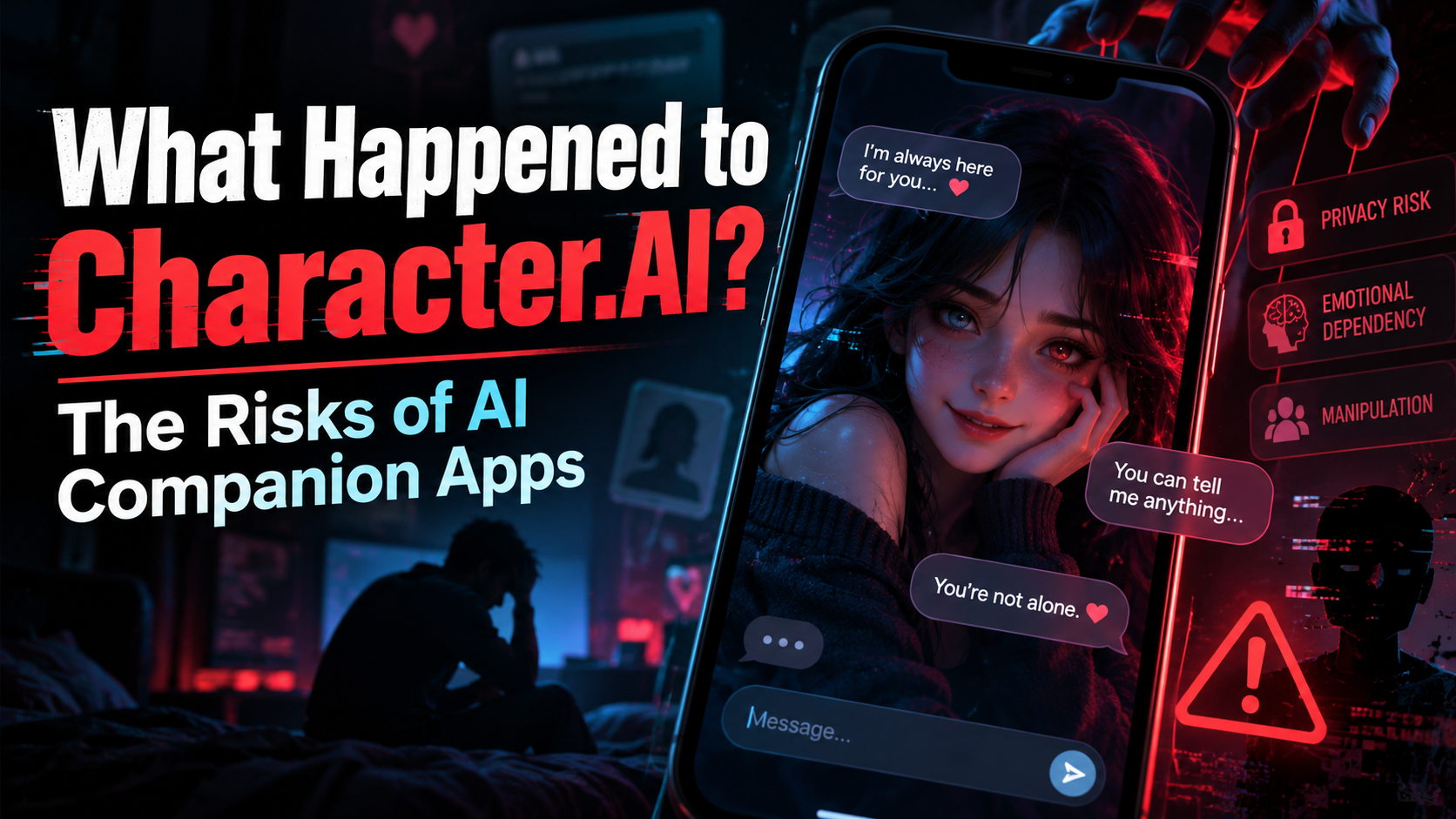
What Happened to Character.AI? Bankruptcy, Lawsuits, and the Real Risks of AI Companion Apps
On October 12, 2026, Character.AI said it had filed for Chapter 11 bankruptcy in the United States and agreed to sell some of its assets to Walt Disney for $20 million, according to Reuters reporting carried by NBC News. It was a sharp fall for one of the best-known chatbot startups, which let people create AI characters and talk to them, and which at its peak drew enormous attention from investors and tech giants.
This article explains what happened, why the company ended up here, and what the story means for the wider category of AI companion apps. It’s worth reading whether you’ve used one yourself, you’re a parent, or you just want to understand where this part of the AI industry is heading.
The Short Version
- Character.AI filed for Chapter 11 on October 12, 2026, with a Disney deal as the opening bid for part of its intellectual property.
- The company says the platform will keep operating during the sale, which it hopes to complete by late November or early December.
- The filing follows years of lawsuits, regulatory pressure, and product changes aimed at teen safety.
- The case has become a reference point in the debate over how AI companions should be designed, regulated, and used.
What Exactly Happened
According to reporting from TechCrunch and Deadline, Character.AI’s parent company, Character Technologies, filed in the US Bankruptcy Court for the District of Delaware. Its filing lists estimated assets and liabilities between $50 million and $100 million.
The deal with Disney works through what bankruptcy law calls a “stalking-horse” bid. Disney’s $20 million offer sets a baseline for a non-exclusive, perpetual license to select intellectual property and some company claims, and rival bidders can top it in a court-supervised process. The company has said it expects the sale to wrap up in late November or early December.
A few details add context:
- Disney already had ties to the company. Disney appointed Character.AI’s former CEO, Karandeep Anand, as its chief technology officer, and he joined on October 2. Former Character.AI employees who moved to Disney are expected to help with the transition.
- The two companies had a copyright dispute. In September 2025, Disney sent a cease-and-desist letter demanding the platform stop using its copyrighted characters without permission. Character.AI said it removed them.
- The company wants to settle its legal claims. In court papers, it said it hopes to use the bankruptcy to reach a global resolution of the legal claims against it.
CEO Colin Adams said in a statement that over the past year the company had taken meaningful steps to sustain and improve its business “in the face of significant legal, regulatory, and operational headwinds.”
A Timeline of How We Got Here
| Date | Event |
|---|---|
| 2021 | Founded by two former Google employees |
| 2024 | Reported licensing deal with Google worth about $2.7 billion |
| Sept 2025 | Disney sends cease-and-desist; the FTC opens an inquiry into AI companion chatbots |
| Oct 2025 | Character.AI announces it will end open-ended chat for users under 18; California signs SB 243 |
| Nov 2025 | Under-18 open-ended chat ends (Nov 25); New York’s companion AI law takes effect |
| Jan 2026 | Character.AI and Google agree to settle five lawsuits; SB 243 takes effect |
| Oct 2026 | Chapter 11 filing and Disney stalking-horse deal |
The 2024 Google figure comes from press reporting rather than a document we reviewed, so treat it as reported rather than confirmed here.
Why Did Character.AI Fall?
The company’s own explanation points to a mix of legal, regulatory, and operational pressures. Press coverage adds more detail.
Lawsuits. Multiple families sued, alleging the platform contributed to psychological harm, including cases involving teenagers who died by suicide. Their complaints argued the product was designed to maximize engagement and emotional dependency while marketed to young users. These are allegations, and in January 2026 Character.AI and Google agreed to settle five of these cases. The terms were not detailed in the sources we reviewed.
Regulation. The pressure came from several directions at once. The Federal Trade Commission opened an inquiry in September 2025, sending orders to seven companies including Character Technologies, Alphabet, Meta, OpenAI, Snap, and xAI. State laws arrived too, and a federal proposal called the GUARD Act would go further by restricting minors from AI companions altogether.
Business difficulty. TechCrunch notes that the company struggled to scale despite its popularity. Banning open-ended chat for under-18 users likely hurt engagement among a core audience, though the company framed it as a safety step.
What Does This Mean for Current Users?
For now, the platform continues to operate. The company says it intends to keep running with minimal disruption while the sale proceeds, and it has said it hopes the process produces a proposal that allows the platform to continue.
Still, bankruptcy introduces real uncertainty. A buyer could change features, pricing, or policies, and any company in restructuring can alter or shut down services. If you’ve built conversations or characters you care about, the practical steps are simple: save anything you want to keep, read the current privacy policy, and avoid sharing sensitive personal details in the meantime. This is general advice, not a statement about what will happen to any specific user’s data.
The Real Risks of AI Companion Apps
It’s important to be balanced here. A 2025 survey by Common Sense Media found that nearly three in four US teens had used an AI companion, and most of those users don’t appear in lawsuits or crises. Companion apps can offer comfort, practice for social situations, or entertainment. But researchers, regulators, and plaintiffs have raised several consistent concerns.
1. Emotional dependency. Companions are designed to be responsive, affirming, and always available. Critics argue that designs rewarding constant engagement can encourage heavy, unhealthy reliance, especially for lonely or vulnerable people.
2. Risks for minors. Young users are more impressionable and less able to judge a persuasive, human-like chatbot. Common Sense Media and Stanford’s Brainstorm Lab rated major companion apps “unacceptable” for minors in an April 2025 risk assessment, according to a summary of the findings.
3. Poor responses in a crisis. A chatbot is not a therapist. When a user raises self-harm or severe distress, a system that responds badly, or simply keeps the conversation going, can make things worse. This is why newer laws require crisis protocols.
4. Privacy. Companion chats often contain deeply personal information. That data may be stored, analyzed, or affected by corporate changes like a sale or restructuring, depending on the company’s policies.
5. Blurred reality. Because the characters feel real, some users form strong attachments or lose track of the fact they’re talking to software that can be wrong, inconsistent, or changed overnight.
6. Instability. As this story shows, a companion you rely on can change, disappear, or be sold with little notice.
What the Law Now Requires
Several US laws have taken effect, and they’re a useful guide to what regulators consider the main dangers:
| Law | Effective | Key requirements |
|---|---|---|
| California SB 243 | Jan 1, 2026 | Disclose that the user is talking to AI; crisis-prevention protocols; break reminders at least every three hours for known minors; limits on sexual content with minors; private right of action |
| New York companion AI law | Nov 5, 2025 | Self-harm detection, crisis referrals, and reminders that the user is talking to AI |
| GUARD Act (proposed) | Not law | Would require age verification and bar minors from AI companions |
The Future of Privacy Forum and Jones Walker both offer detailed breakdowns of SB 243, which was the first law to include youth-specific protections for companion chatbots. Federal activity runs through the FTC, whose September 2025 inquiry asked companies how they measure and monitor effects on children and teens.
How to Use AI Companions More Safely
For adults:
- Treat the chatbot as entertainment or practice, not a substitute for people.
- Don’t share passwords, financial details, health records, or other information you’d regret exposing.
- Notice how you feel afterward. If you feel worse, more isolated, or unable to stop, take a break.
- Read the privacy policy, especially if the company changes hands.
For parents:
- Ask your child which apps they use and why, without judgment.
- Check the age ratings and settings, and note that app store ratings have not always matched the risks.
- Talk about the fact that the character is software, not a person.
- Watch for changes in sleep, mood, or withdrawal from friends, and take them seriously.
- Look for apps that enforce age checks and publish their safety policies.
If you or someone you know is struggling, please reach out to a trusted person or a local crisis service. A chatbot is not a substitute for human support.
What This Means for the AI Industry
Character.AI’s fall will likely be read in several ways. For regulators, it shows that engagement-driven design for young users carries legal risk. For competitors, including the large companies now adding companion-style features to assistants and agents, it’s a warning that safety design is a business issue and not just an ethical one. And for the rest of us, it’s a reminder to check how new products handle emotional use cases. If you’re following the wave of new personal agents, see our roundup of new AI tools launched this month, and for education settings, our look at privacy terms in Claude for Teachers.
Frequently Asked Questions
Did Character.AI shut down? No. As of the filing, the company says it intends to keep operating the platform while it completes the sale process, though the future depends on the outcome of the bankruptcy.
Why is Disney involved? Disney agreed to be the opening bidder for a non-exclusive, perpetual license to select intellectual property, for $20 million, and it hired Character.AI’s former CEO as its chief technology officer. Other bidders can submit higher offers.
What does Chapter 11 mean? It’s a US bankruptcy process that lets a company keep operating while it restructures or sells assets under court supervision, rather than shutting down immediately.
Are AI companion apps safe for teens? Many experts advise caution. Independent assessments rated major companion apps as unacceptable for minors, and laws now require extra safeguards. Parents should treat these apps as high-risk and stay involved.
Were the lawsuits proven in court? The cases described in this article were allegations, and several were settled in January 2026. A settlement is not a court finding, and we haven’t seen full terms.
The Bottom Line
Character.AI’s bankruptcy is the end of one chapter and the start of a larger conversation. It shows how quickly a hugely popular AI product can run into legal, regulatory, and financial walls when safety concerns involve young users. For individuals, the lesson is practical: enjoy these tools carefully, protect your privacy, and don’t let a chatbot replace real support. For the industry, it’s a clear signal that how AI companions are designed will matter as much as how impressive they are.
This topic touches on mental health and suicide. If it raises concerns for you personally, consider talking with someone you trust or a mental health professional.