























How Gemini 4 Argon Agents Beat Minecraft’s Ender Dragon: What the Experiment Really Shows
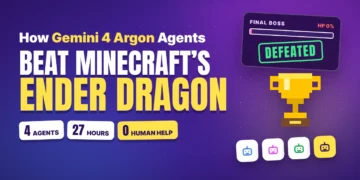
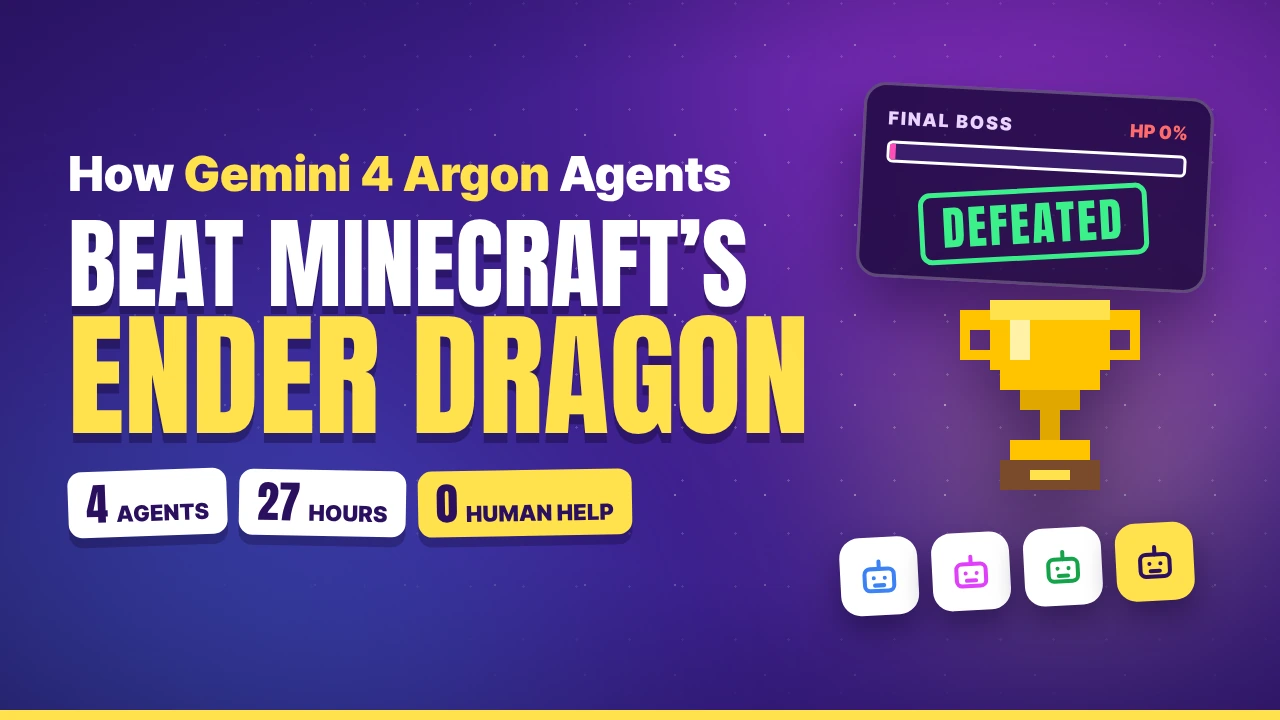
A group of AI agents has reportedly beaten the Ender Dragon, the final boss of Minecraft, in a randomly generated survival world with no human help. The agents ran on Google’s new Gemini 4 Argon model, and the result comes from a Google research paper reported by several outlets in the days after October 19, 2026.
It makes a great headline. It is also easy to over-read. This article walks through what was reported, puts the numbers in context, and separates what the experiment shows from what it does not.
A note on sources: I could not open the original paper (arXiv listing 2610.22319, as cited by Tech Edition), so everything below comes from news coverage and Google’s own model documentation. Where I do my own arithmetic, I say so.
What Happened, in Short
According to Engadget, published October 19, 2026, and Tech Edition, published October 20, Google researchers set four Gemini 4 Argon agents loose in a sandboxed, randomized survival world. Their goal was to defeat the Ender Dragon. The agents were not given roles, strategies, or game-specific tools. Each controlled its own player through Mineflayer, an open-source library for programming Minecraft bots, and they coordinated by in-game chat and shared memory. A fifth agent, called the Observer, watched the session to check for cheating and produced reports.
The run took 27.23 hours, mostly spent on the dragon fight itself, and ended with the dragon defeated.
The Numbers at a Glance
| Measure | Reported figure |
|---|---|
| Agents playing | 4 (plus 1 Observer) |
| Duration | 27.23 hours |
| Programs written and run | 2,783 |
| Messages exchanged | 229 |
| Deaths | 605 |
| Input tokens used | 1.35 billion |
| Estimated cost | $810 at Gemini list price, or $1,620 at a “standard” price cited in the reports |
| Human intervention | None, according to the researchers |
These figures are repeated across the Engadget and Tech Edition coverage, and a third outlet, Inkorr, reports the same set. Because all three are summarizing the same paper, they are not independent confirmation of each other.
How the Agents Worked Together
The most interesting part is not that the dragon died. It is how the work was divided.
No assigned roles
The reports say the agents were not told who should do what. Even so, each settled into a specialty:
- One agent concentrated on making tools.
- One gathered food and supplies.
- One lit the key portal.
- One built shelters against Endermen (the tall creatures that are dangerous to look at) and landed the final blow.
They also recovered items from teammates who had died, which matters in a game where death drops your inventory.
Shared memory and chat
Agents posted tips, warnings, and coordinates to in-game chat and shared memory. In practical terms, that is the same idea behind many business “agent teams”: several model instances, each with a partial view, using a shared notebook to stay in sync.
Code as the action layer
The agents wrote and executed 2,783 programs. That is a notable detail. Instead of clicking buttons, they generated code against the Mineflayer library to move, mine, craft, and fight. (Mineflayer is a programming interface for Minecraft bots, so “playing” here means writing scripts, not controlling a mouse.) The same pattern is how many coding agents operate: write a small program, run it, read the result, fix it.
An AI referee
The Observer agent checked the session for cheating and issued reports. Neither report I read explains how the Observer verified integrity, and the Observer is itself an AI agent, so treat its role as a design choice rather than independent proof.
Why Minecraft Is a Meaningful Test
Minecraft is a popular benchmark for agents because it demands things short tasks do not:
- Long chains of dependent steps. You cannot fight the dragon without a portal, and you cannot build a portal without materials, and you cannot gather materials without tools. The researchers said the agents had to keep a coherent plan across thousands of dependent steps for more than a day, per Tech Edition.
- Open-ended goals. There is no menu of actions, just a world.
- Recovery from failure. Dying and re-planning is normal.
- Randomized worlds. The agents could not memorize one map.
The researchers described the result as, to their knowledge, the first fully autonomous Minecraft completion by AI agents using only the standard Mineflayer library. That “first” claim is theirs, hedged with “to our knowledge,” and I could not check it independently.
What the Result Does Not Prove
Several caveats matter before anyone calls this a milestone for real-world autonomy.
It was a sandbox. Tech Edition notes the test took place in a controlled digital environment with a defined objective, so it does not show that agents would reliably do similar jobs in the real world.
It looks like a single run. Inkorr’s report describes one playthrough. If that is right, there is no information on variance: would the same team succeed again, or did it get lucky over 605 deaths? Engadget does not say whether this was one run or several.
It was inefficient. Dying 605 times in 27 hours is not smooth play. Tech Edition frames the result as evidence of capability, not efficiency.
It was expensive. More on that below.
Single-sourced facts. The numbers come from Google’s own paper. No independent lab has been reported replicating it.
The environment is well documented. Large models have likely seen a lot of Minecraft guides and code. The reports do not discuss that, so I will not claim it either way, but it is a fair question to ask when you read the paper.
What It Cost
The reports give two price figures: $810 at Gemini’s list price and $1,620 at a standard price. They do not explain the difference, and which one applies depends on the pricing basis used.
My own arithmetic, using only the reported figures (not from the paper):
- 1.35 billion input tokens over 27.23 hours is roughly 50 million input tokens per hour.
- $810 over 27.23 hours is roughly $30 per hour; $1,620 is roughly $60 per hour.
- 2,783 programs over 27.23 hours is about 100 programs per hour.
These are rough averages across the whole team, not per agent, and they cover input tokens only, as the reports state them.
The point is scale. One long agentic task used over a billion tokens. A human can beat the Ender Dragon for the price of a game they already own. That gap is why cost-per-task, not just success, is the number to watch as agents move into business use.
The Model Behind It: Gemini 4 Argon
Google’s developer documentation, last updated October 14, 2026, describes Gemini 4 Argon (gemini-4-argon) as its flagship reasoning model, built for complex software engineering, advanced math and science, autonomous multi-step agents, and long decoding.
Facts from that page:
- Context window: 1,048,576 tokens, shared by input and output.
- Output: 65,536 tokens by default for synchronous requests, up to 1,048,576 tokens with long decoding.
- Inputs: text, images, video, audio, and PDFs. Output: text only.
- Supported: code execution, function calling, structured output, URL context, Google Search and Maps grounding, file search, computer use (preview), and adjustable thinking levels (low, medium, high).
- Not supported: image generation, speech generation, and the Live API.
- Caching: implicit caching only.
- Pricing: the page does not list prices; it points to a separate pricing page.
- Availability: the page says it is available now and can be tried in Google AI Studio.
Which of those capabilities the Minecraft agents used is not clear from the coverage I read. Code execution and long context are the likely foundations, but that is my inference, not a reported fact.
For the model’s consumer access and plans, see our roundup of the latest AI tool releases, where I flagged that plan details came from a secondary recap.
Why It Matters Beyond Gaming
Even with the caveats, the experiment points to trends worth knowing about.
Agent teams, not single agents. The work was split across several model instances that coordinated. That is increasingly how companies describe agent products, including the consumer “do it for me” assistants we covered in our explainer on Claude Duet.
Long-horizon planning is the hard part. A task that spans more than a day and thousands of steps is much harder than answering a question. Progress there is what separates a chatbot from an agent.
Cost and reliability are the bottlenecks. The success is real in the reports, but a $810 to $1,620 bill and 605 deaths show how far the economics have to go.
Verification matters. The Observer idea, using one agent to audit others, is likely to show up in business tools. Its limits are the same as any AI judge: it is only as trustworthy as its design.
Shopping and decisions. As agents act for people, accuracy matters more. Our piece on how AI recommendations change which brands people buy shows why.
Questions to Ask When You Read the Paper
If you can open the original paper, these are the questions worth checking first. They are my suggestions, not claims from the coverage.
- How many runs were attempted, and how many succeeded? One success out of one try tells you less than four out of five.
- What exactly counts as “no human intervention”? Check whether people set up the world, restarted crashed processes, or adjusted prompts mid-run.
- How did the Observer work? Look for what it could see, and what rules it applied.
- What was the token price basis? The gap between $810 and $1,620 should be explained in the methods.
- What happened in failed attempts? Failures often teach more than the final success.
- Were the agents given any hints in their instructions? Even a short goal description shapes behavior.
Answers to these would turn an impressive headline into something you can compare with other agent research.
Timeline of the Reports
- October 14, 2026: Google’s developer page for Gemini 4 Argon shows its last-updated date, and a recap the same day describes the model’s arrival.
- October 19: Engadget reports the Minecraft result, based on a new Google paper.
- October 20: Tech Edition publishes its own report and cites the arXiv paper.
- Later coverage: other outlets repeat the same figures.
Common Mistakes When Reading This Kind of News
Treating a benchmark as a job. Beating a game boss in a sandbox is not the same as running a store or a bank account.
Ignoring the cost line. Success at any price is not a product.
Counting echoes as confirmation. Many outlets repeating one paper are one source.
Skipping the limitations. The most useful sentences are often the hedges, like “to our knowledge.”
Assuming it is reproducible. One run does not show reliability.
Frequently Asked Questions
Did AI really beat Minecraft? According to Google researchers, four Gemini 4 Argon agents defeated the Ender Dragon without human intervention. The claim is reported by multiple outlets summarizing one paper, and I could not read the paper itself.
Is this the same as the Gemini and Dragon Quest news? No. Separate reports say Square Enix is adding Google Gemini as a helper in Dragon Quest X. I saw only headlines for that story, so I do not cover it here.
How long did it take? 27.23 hours, most of it on the dragon fight, according to the reports.
How much did it cost? Reported as $810 at Gemini list price or $1,620 at a standard price, for 1.35 billion input tokens.
Can I try Gemini 4 Argon? Google’s page says it is available and can be tried in Google AI Studio. Pricing and limits for your plan are on Google’s pricing page, which I could not confirm.
Does this mean AI agents are ready to run my work? Not on this evidence alone. It shows long-horizon coordination in a game world, at a high token cost.
The Bottom Line
Four Gemini 4 Argon agents coordinating for 27 hours to beat the Ender Dragon is a striking demonstration of long-horizon, multi-agent planning. It is also a single sandbox result, reported from Google’s own paper, with a large bill and hundreds of deaths along the way. Read it as a sign of where agent research is heading, not as proof that agents are ready for unsupervised real-world work. When the paper’s details are easier to check, they are the best source for what the agents did and did not do.