









The Newest AI Models of 2026: A Complete, Professional Breakdown


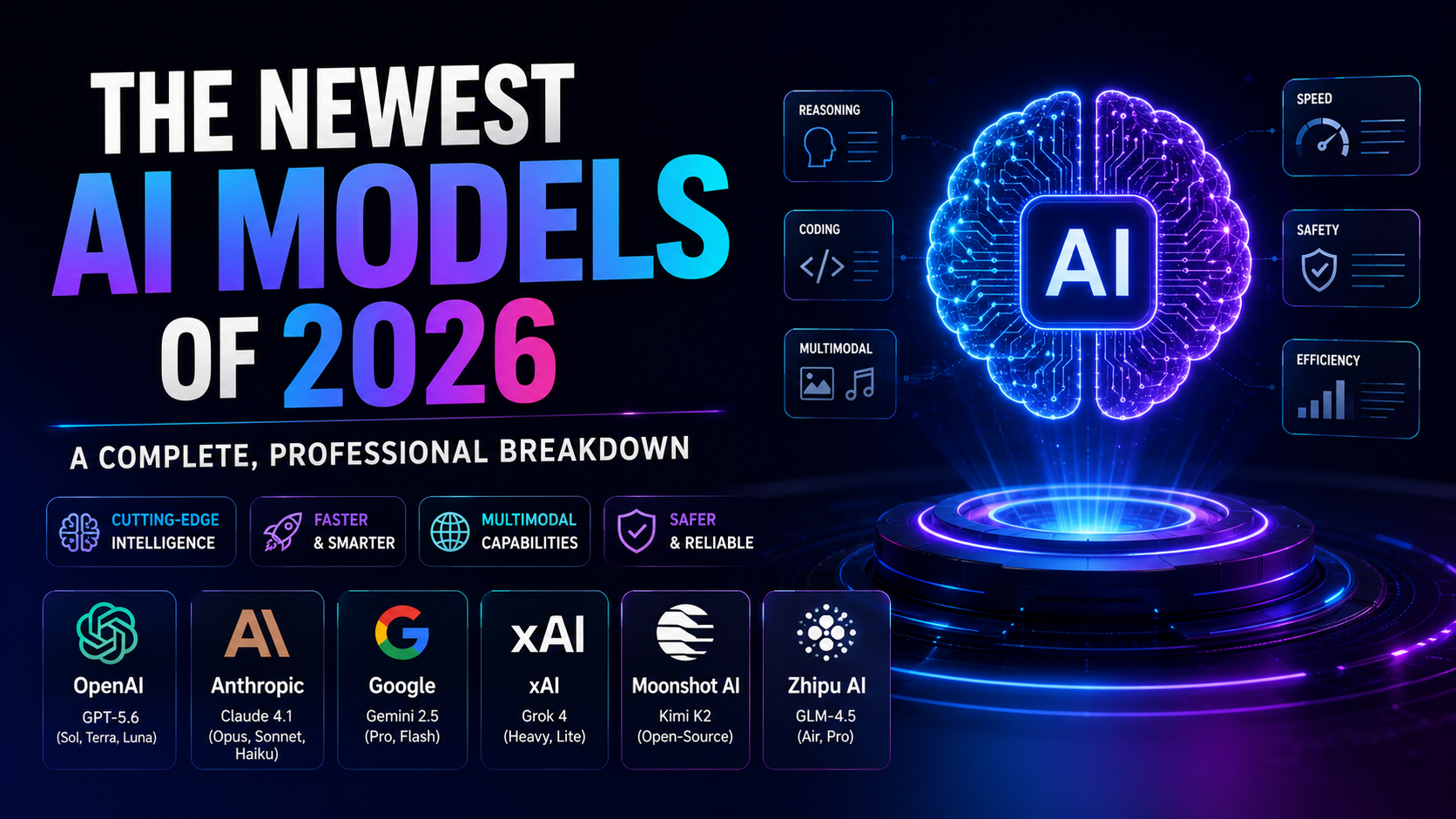
The pace of AI model releases in 2026 has made “the best model” a moving target that shifts roughly every few weeks. Between June and late July alone, six major labs — OpenAI, Anthropic, Google, xAI, Moonshot AI, and Zhipu AI — shipped eight significant new models, each claiming leadership in at least one benchmark category. Keeping track of what’s actually new, and which model genuinely leads where, has become a real challenge even for people following the space closely.
This is a professional, no-hype breakdown of the newest AI models as of late July 2026 — what each one does differently, where it actually leads, and which one fits which kind of work.
OpenAI: The GPT-5.6 Family
OpenAI’s GPT-5.6 family reached general availability on July 9, 2026, split into three tiers: Sol as the flagship model, with Terra and Luna as lighter, cheaper variants for less demanding tasks. Sol Ultra, the top configuration, introduced cooperative subagents — multiple agent instances working different parts of a complex task in parallel rather than sequentially — along with a Cerebras-hardware fast mode for latency-sensitive applications. Codex, OpenAI’s dedicated coding agent product, now runs on Sol Ultra by default.
Where it leads: GPT-5.6 Sol remains a top performer on several agentic coding evaluations, including DeepSWE, and its subagent architecture gives it a genuine edge on tasks that benefit from parallel execution rather than a single sequential reasoning chain.
Anthropic: Four Models in Under Two Months
Anthropic had the most active release cadence of any lab this summer, shipping Claude Mythos 5 and Claude Fable 5 on June 9, Claude Sonnet 5 on June 30, and Claude Opus 5 on July 24 — four distinct models in under eight weeks. Fable 5 sits at the top as Anthropic’s most capable general model; Mythos 5 is a restricted-access variant for vetted cybersecurity and biology research partners; Sonnet 5 is built specifically for long agentic coding sessions at a lower cost; and Opus 5, the newest, is positioned as approaching Fable 5’s intelligence at roughly half the price, with a new effort toggle letting users trade cost against capability per task.
Where it leads: On GDPval-AA v2, a human-graded knowledge-work evaluation, Claude Opus 5 currently leads outright, ahead of both Fable 5 and GPT-5.6 Sol. On the hardest coding benchmark, SWE-bench Pro, Mythos 5 and Fable 5 remain narrowly ahead of every other model on this list. We covered Opus 5’s full launch details, benchmarks, and pricing in a dedicated deep dive.
Google: A Flash-First Strategy
Google released Gemini 3.6 Flash on July 21, 2026, alongside a lighter Gemini 3.5 Flash-Lite variant and a narrow, security-focused Gemini 3.5 Flash Cyber model. Notably, Google chose to ship its faster, cheaper tier before its next-generation flagship — Gemini 3.5 Pro remains in partner testing and hasn’t reached general availability as of this writing. Gemini 3.6 Flash cut output pricing by roughly 17% compared to its predecessor while also using about 17% fewer output tokens to complete comparable tasks, and it pushed its knowledge cutoff forward to March 2026.
Where it leads: On raw cost efficiency, Gemini 3.6 Flash is difficult to beat among comparable-tier models from any lab. It also retains Google’s structural advantage in native multimodal processing — handling video and audio directly without bolting on separate tools — and live Google Search grounding with inline citations.
xAI: A Pivot Toward Business and Coding
xAI released Grok 4.5 in early July 2026, explicitly repositioned toward business and coding use cases rather than the more casual, social-platform-oriented framing of earlier Grok versions. Grok 4.5 directly powers Grok Build, xAI’s coding agent product, which was trained in close collaboration with Cursor — a detail that shows up in how well it handles Cursor’s own workflows specifically.
Where it leads: Pricing. Grok Build runs at $2 per million input tokens and $6 per million output tokens, among the most competitive rates of any serious coding-capable model currently available, making it a strong pick for cost-conscious teams that don’t need the absolute top benchmark score.
Moonshot AI: The Open-Weight Scale Record
Moonshot AI released Kimi K3 on July 16, 2026 — a 2.8-trillion-parameter Mixture-of-Experts model that became the largest open-weight AI model released to date. Despite the scale, its sparse architecture activates only a small fraction of its total parameters per request, keeping practical inference costs manageable. It ships with a 1-million-token context window and reportedly ranked first among blind developer evaluations on the Frontend Code Arena benchmark.
Where it leads: Scale and openness combined. No other model on this list matches K3’s parameter count while remaining genuinely open-weight, making it the strongest option for organizations that need to self-host a frontier-scale model rather than depend on a proprietary API.
Zhipu AI: The Open-Weight Coding Leader
GLM 5.2, released by Zhipu AI, took the top spot among fully open-weight models specifically on coding benchmarks as of the July 2026 rankings refresh. Unlike Kimi K3’s scale-focused positioning, GLM 5.2 is tuned more narrowly toward practical coding performance for teams that need to self-host without going through any proprietary API at all.
Where it leads: Open-weight coding specifically — for teams with the GPU infrastructure to self-host, GLM 5.2 currently offers the strongest coding performance available outside a proprietary API.
How These Models Actually Compare
| Model | Company | Released | Strongest At | Price (per 1M tokens) |
|---|---|---|---|---|
| GPT-5.6 Sol | OpenAI | July 9, 2026 | Parallel agentic coding | $5 / $30 |
| Claude Opus 5 | Anthropic | July 24, 2026 | Knowledge work, cost-to-performance | $5 / $25 |
| Claude Fable 5 / Mythos 5 | Anthropic | June 9, 2026 | Hardest coding benchmarks | $10 / $50 |
| Gemini 3.6 Flash | July 21, 2026 | Cost efficiency, multimodal | $1.50 / $7.50 | |
| Grok 4.5 (via Grok Build) | xAI | Early July 2026 | Budget coding | $2 / $6 |
| Kimi K3 | Moonshot AI | July 16, 2026 | Open-weight scale | $3 / $15 |
| GLM 5.2 | Zhipu AI | July 2026 | Open-weight coding | Free (self-hosted) |
A Note on Benchmark Claims
Nearly every “leads at” claim above comes from benchmark testing, and it’s worth being precise about what that actually means before treating any of it as gospel. Most of these figures come from each lab’s own reported testing, run under conditions the lab itself controls — Anthropic’s Frontier-Bench numbers, for instance, come from an internal harness, and independent verification typically lags a few weeks behind a model’s actual release. Where independent aggregators like Artificial Analysis have published their own rankings, the broad picture has generally held up, but individual benchmark scores can shift meaningfully once outside researchers get direct access.
The practical implication: treat every ranking in this piece as a strong starting signal for which model to test first, not a guarantee of how it will perform on your specific workload. A model that leads on a coding benchmark built around isolated problems doesn’t automatically win on a messy, real-world codebase with unusual conventions and legacy code — and the only way to know for sure is to run your own comparison against the actual task you need done.
What’s Actually Driving This Pace
A few structural forces explain why six labs shipped eight major models in under two months. Competitive pressure from Chinese open-weight labs like Moonshot and Zhipu has pushed every proprietary lab to defend both benchmark leadership and pricing simultaneously, since an expensive proprietary model now has to justify its cost against a genuinely capable free alternative. Training and evaluation cycles have also compressed significantly compared to 2024 and 2025, making a release cadence of every few weeks operationally realistic in a way it simply wasn’t before. And increasingly, cost-to-performance has become as important a competitive axis as raw capability — reflected clearly in Anthropic’s effort-toggle feature on Opus 5 and Google’s decision to ship its cheaper Flash tier ahead of its flagship Pro model.
Which Model Should You Actually Use?
- Best raw coding performance: Claude Mythos 5 or Fable 5, for teams with access and budget for the absolute frontier.
- Best cost-to-performance for daily professional work: Claude Opus 5, particularly with its effort toggle for controlling spend.
- Best for parallel, multi-step agentic tasks: GPT-5.6 Sol Ultra, given its subagent architecture.
- Best value for cost-conscious teams: Gemini 3.6 Flash or Grok Build, depending on whether multimodal capability or coding-specific performance matters more.
- Best for self-hosting: Kimi K3 for scale, or GLM 5.2 for coding-specific performance, both requiring serious GPU infrastructure.
For a deeper, use-case-specific comparison between the three largest consumer platforms, see our full ChatGPT vs. Claude vs. Gemini breakdown.
Frequently Asked Questions
Which AI model is the newest as of late July 2026? Claude Opus 5, released by Anthropic on July 24, 2026, is the most recent major model release covered here, though the pace of releases means this answer changes quickly — expect another major release within weeks.
Which model is best overall? There’s no single best model across every category. Claude’s Mythos 5 and Fable 5 lead on the hardest coding benchmarks, Claude Opus 5 leads on cost-adjusted knowledge work, and Gemini 3.6 Flash leads on raw affordability. The right choice depends on the specific task and budget.
Are open-weight models like Kimi K3 and GLM 5.2 actually competitive with proprietary models? Yes, increasingly so. Both have posted benchmark results competitive with, and in some specific categories ahead of, proprietary models from major labs, though running them yourself requires meaningful GPU infrastructure that most individuals and small teams don’t have.
How often should I expect a new “best” model to come out? Based on the pace through mid-2026, expect a significant new release from at least one major lab every few weeks. Treating any single model as a permanent leader is no longer a safe assumption in this market.
Is it worth switching platforms every time a new model launches? Generally no, for most everyday use. Switching costs — rebuilding custom workflows, prompts, or integrations — often outweigh the marginal benchmark gains of a brand-new release, unless the new model addresses a specific limitation that was actually affecting your work.
The Bottom Line
The newest AI models of 2026 tell a consistent story: raw intelligence has stopped being the only axis labs compete on. Cost efficiency, agentic reliability, and self-hosting flexibility now matter just as much as benchmark leaderboards, and every major lab covered here is competing on some combination of all four simultaneously. For most people and businesses, the practical move isn’t chasing whichever model tops this week’s leaderboard — it’s matching a model’s specific strength to the actual task at hand, and revisiting that choice periodically rather than assuming today’s answer will still be right in a month.