

















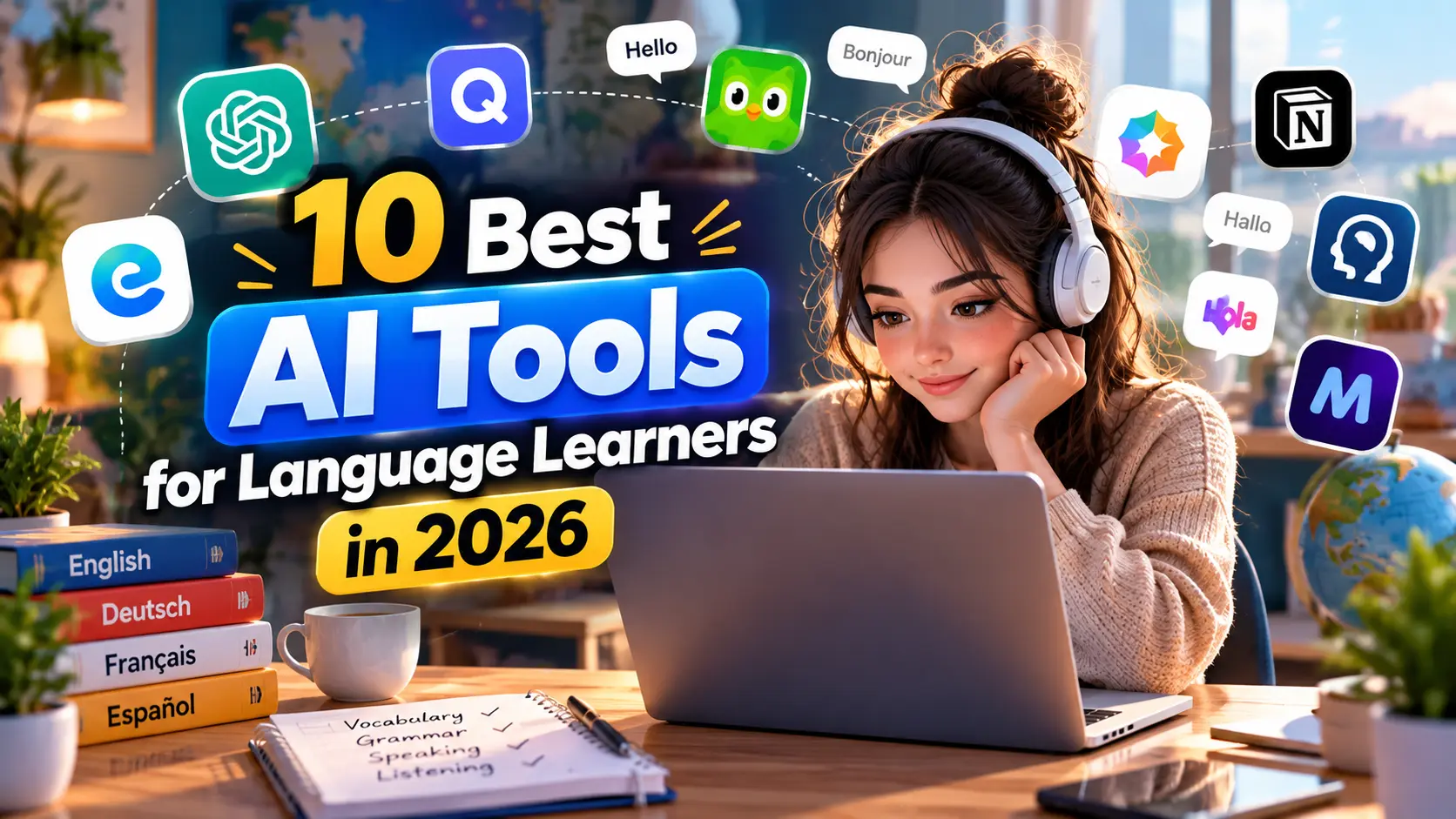
10 Best AI Tools for Language Learners in 2026
[IMAGE 1 — Hero: a person with headphones speaking into a laptop at a kitchen table, with a notebook and a coffee cup beside them. Suggested search: “person headphones laptop language practice at home” on Unsplash. Alt text: “AI language learning app for speaking practice at home”]
Language learning is one of the areas where AI can help most, and also where a weak app can waste months. Flashcards and grammar drills have been easy to build for years. What AI adds is the part that used to need a human tutor: a conversation partner who never gets tired, feedback on your pronunciation, and practice that adapts to what you got wrong last time.
This guide covers ten AI tools that language learners use in 2026. For each one, you will see what the free plan includes, what the paid plan costs where I could confirm it, and where the app falls short. Language app prices change often and differ by country, so treat every number here as a starting point and check the app before you pay.
How to Choose the Right Tool
Before you compare apps, decide what you need most. The right tool depends on the skill you are trying to build:
- Speaking confidence: Look for open conversation with an AI tutor and feedback on your phrasing.
- Pronunciation: Look for apps that score individual sounds and stress patterns.
- Daily habit: Look for short lessons with reminders and streaks.
- Exam preparation: Look for apps that cover speaking tests such as IELTS or TOEIC.
- Work or travel phrases: Look for role-play scenarios that match your goal.
Most learners do best with one structured app for daily habit and one conversation tool for speaking. Adding a third is rarely necessary.
How We Picked These Tools
Many official pricing pages would not load for us, and some apps list prices only inside the app. Where I could not confirm a price on the vendor’s own page, I say so, and I give the figure from a secondary source with its date. We left out comparison sites that rank their own apps first without disclosing that they had no outside test data.
The Ten Tools
1. Duolingo
Duolingo is the best-known free language app, and it is still the easiest way to build a daily habit. The free plan is supported by ads, includes core lessons in most languages, and limits how many mistakes you can make before you lose a “heart.”
The paid tiers are Super, which removes ads and unlocks unlimited hearts, and Max, which adds AI features. A third-party tracker updated in September 2026 lists Super at $6.99 a month on annual billing, or $83.88 a year, and Max at $14 a month on annual billing, or $168 a year, with Max at $29.99 on a monthly, pay-as-you-go basis. Duolingo’s own pricing page did not load for us, so check it before you subscribe.
Max includes AI Roleplay, an AI Video Call with the character Lily, and Explain My Answer, which gives feedback on mistakes. According to the same tracker, Max is available only in select markets and for select languages, and the roleplay and video features launched first for English speakers learning Spanish and French.
Best for: daily habit and beginners.
Watch out for: Max is not offered everywhere. Also, the speaking practice is shallower than in dedicated speaking apps, and its business English content is limited.
2. Speak
Speak is built around speaking practice. Its AI tutor holds open conversations on everyday and work topics, and it gives feedback on grammar, phrasing, and roleplay. The official FAQ describes two paid plans, Premium and Premium Plus, with Premium Plus adding unlimited personalized lessons and a lesson creator for the tutor. A 7-day free trial is offered, after which a subscription is required.
The official pages I could open did not list prices. A May 2026 comparison lists Premium at $20 a month and Premium Plus at $30 a month, but that source is a publisher that discloses it may earn commissions, so confirm the figures in the app. Speak currently teaches seven languages.
Best for: learners who want to speak more and think in the target language.
Watch out for: the trial ends automatically, so set a reminder to cancel if the app does not fit your goals.
3. ELSA Speak
ELSA Speak specializes in pronunciation. It highlights the sounds you get wrong, compares your audio with a native speaker, and gives feedback on rhythm and stress. Its individual plan includes a free tier with AI role-plays, a speech analyzer, and progress tracking. Paid individual plans are reported by one May 2026 comparison at $12 to $18 a month, or $70 to $90 a year, although the official site did not show prices when we checked. ELSA also sells business and school plans with custom pricing.
Best for: pronunciation and accent work, especially for English learners preparing for speaking exams.
Watch out for: open conversation is less developed than in Speak, so pair it with a conversation tool if you want more back-and-forth practice.
4. Praktika
Praktika offers an AI tutor with four named personalities, and you can set the tutor’s tone to soft, balanced, or strict. It builds a study plan around your goals and pace, and it gives feedback on messages and pronunciation. Its free-talk option lets you chat about any topic.
The homepage shows a price of about $8 a month, but it does not list plan names or billing terms. Reviewers describe a free version with a paywall for some features. Check the current terms in the app before you commit.
Best for: learners who want a tutor with a personality and a structured plan.
Watch out for: the homepage does not list lesson limits, so test the free version and see how much you can practice before you pay.
5. TalkPal
TalkPal covers more than 130 languages, which makes it useful if you are learning a less common language that other apps skip. Its free basic plan includes a 10-minute daily limit on AI practice, plus basic chat, personalized learning, progress tracking, and a pronunciation assessment tool. Paid plans remove the daily limit, unlock all AI modes, and add daily feedback. Each paid plan includes a 14-day free trial.
The pricing page shows no monthly or annual prices, and it says prices vary by location.
Best for: less common languages and learners who want a free starting point.
Watch out for: a 10-minute daily limit is short for serious speaking practice, so plan to upgrade if you want more than a quick session.
6. Loora
Loora is an English-focused speaking app. It offers open conversation, work and exam scenarios, and instant feedback on pronunciation, grammar, and fluency. It runs on a free trial followed by a paid subscription. We could not confirm its current prices on the vendor’s page, so check the app before you subscribe.
Best for: English learners who want speaking practice for work or exams.
Watch out for: Loora covers English only, so it will not help if you are learning another language.
7. Pingo
Pingo covers more than 25 target languages and lets you set a goal before each session. Its real-time role-play is designed around that goal, and it remembers past mistakes so it can revisit them later. Pingo also runs on a free trial followed by a paid subscription. We could not confirm its prices on the vendor’s page.
Best for: role-play and goal-based speaking practice in a wide range of languages.
Watch out for: a subscription is needed for unrestricted conversation, so the free trial may not show you how much you will use each week.
8. ChatGPT Advanced Voice
ChatGPT’s voice mode lets you have a spoken conversation in many languages. It is fast, open-ended, and available on the free plan with usage limits. You can ask it to play a barista, a job interviewer, or a travel guide, correct your grammar as you go, and explain the word you should have used.
The free plan is enough to try the method. ChatGPT Plus costs $20 a month and gives you more time for voice practice.
Best for: free, open-ended speaking practice and specific roleplay scenarios you design yourself.
Watch out for: ChatGPT has no built-in curriculum, so you have to plan your own practice. Give it a clear role, a level, and a goal in your first message.
9. Google Translate Practice
Google Translate added a language practice mode in 2025, built on Gemini. You set your level and goals, and the app builds everyday-scenario exercises. There are two types: listening exercises where you tap the words you recognize, and speaking exercises where you say phrases aloud and can request hints. Progress is tracked.
Reporting from August 2025 described practice mode as a beta and said it was free, with language pairs limited to English with Spanish or French, and Spanish, French, or Portuguese with English. We did not confirm its current availability or language pairs in October 2026, so check the app.
Best for: free, low-pressure listening and speaking practice for beginners.
Watch out for: the language pairs are limited and the feature was in beta when it launched, so do not rely on it as your only tool.
10. Cambly
Cambly connects you with native-speaking human tutors, and it has added AI tools for lesson preparation and review. It is the most expensive option on this list. One secondary comparison lists about $159 a month for three lessons a week, and the official plans are subject to change, so confirm current prices before you book.
Best for: learners who want a real person to speak with, especially for business English or accent work.
Watch out for: lessons need scheduling, and the cost adds up quickly. Most learners get better value from an AI conversation tool combined with occasional human tutoring.
Comparison at a Glance
| Tool | Main strength | Free option | Reported paid price | Main limit |
|---|---|---|---|---|
| Duolingo | Daily habit and gamified lessons | Yes, ad-supported | Super $6.99/mo (annual); Max $14/mo (annual) | Max limited to select markets |
| Speak | AI conversation and speaking | 7-day trial only | Not shown on official page; one source lists $20 to $30/mo | Trial ends automatically |
| ELSA Speak | Pronunciation feedback | Yes | One source lists $12 to $18/mo | Conversation less developed |
| Praktika | Tutor personalities and study plans | Yes | About $8/mo on homepage | Plan terms not listed |
| TalkPal | Many languages | Yes, 10 minutes a day | Not shown on official page | Short daily limit |
| Loora | English speaking for work and exams | Free trial | Not confirmed | English only |
| Pingo | Goal-based role-play | Free trial | Not confirmed | Subscription needed for full use |
| ChatGPT Advanced Voice | Open-ended speaking practice | Yes, with limits | Plus $20/mo | No built-in curriculum |
| Google Translate Practice | Free listening and speaking | Yes, beta | Free (reported in 2025) | Limited language pairs |
| Cambly | Human tutors | No | About $159/mo for 3 lessons a week (one source) | Scheduling and cost |
Prices vary by country and change often. Confirm each one in the app before you subscribe.
[IMAGE 2 — A phone showing a speaking exercise with a waveform and a score, next to a notebook with vocabulary notes. Suggested search: “language learning app speaking exercise phone notebook” on Pexels. Alt text: “AI pronunciation feedback in a language learning app”]
Common Mistakes to Avoid
Relying only on AI feedback. AI can point out errors, but it can also be wrong. When you are unsure about a correction, check it with a dictionary, a grammar guide, or a native speaker.
Subscribing to several apps at once. Pick one structured app and one speaking tool. Add another only after you have used the first for a month and know what it is missing.
Practicing only what feels comfortable. AI tutors are patient, which makes it easy to avoid hard topics. Ask for the scenarios that scare you most.
Ignoring pronunciation until late. Early habits are hard to fix later. Use a pronunciation tool in the first few months, even if you mostly want to practice conversation.
Forgetting to cancel a trial. Most apps on this list offer a free trial that converts to a paid plan. Set a reminder before the trial ends.
Assuming a free plan is enough for exam prep. Free tiers often limit daily practice time. Check the limit before you schedule an exam.
Frequently Asked Questions
Can AI replace a human tutor? For daily practice, vocabulary, and confidence building, AI tools can cover a lot of ground. For advanced fluency, accent work, and exam preparation, a human tutor who can react to your specific mistakes is still valuable. Many learners use both.
Which app is best for a complete beginner? Duolingo’s free plan is the easiest way to start a daily habit. Add a conversation tool such as ChatGPT Advanced Voice once you can form simple sentences.
Is Duolingo Max worth it? It depends on whether you want the AI features and whether Max is available in your language and country. If you mostly want daily lessons, the free plan or Super may be enough.
Can I practice speaking for free? Yes. Google Translate’s practice mode and ChatGPT’s voice mode both have free options, although each has limits. TalkPal and Speak also offer free starting points, depending on the plan and the time you have.
Which app is best for pronunciation? ELSA Speak focuses most directly on pronunciation feedback. Praktika and Speak also give pronunciation help, but they are more conversation-focused.
Should I pay for a tutor on Cambly? If you need a real person to correct your speaking and you can afford the cost, yes. Otherwise, start with an AI tool and add a tutor only if you hit a wall.
The Bottom Line
The best AI language learning tools in 2026 do different jobs. Duolingo keeps you practicing every day, Speak and ChatGPT’s voice mode give you conversation, and ELSA Speak helps you sound clearer. Start with a free plan, test each app for a week on the exact skill you need, and pay only for the one that makes you speak more.
For more free AI tools that help with study, see our guide to free AI tools for students. If you are deciding whether a higher-priced AI plan is worth it, our ChatGPT Pro guide explains how to test that decision.