








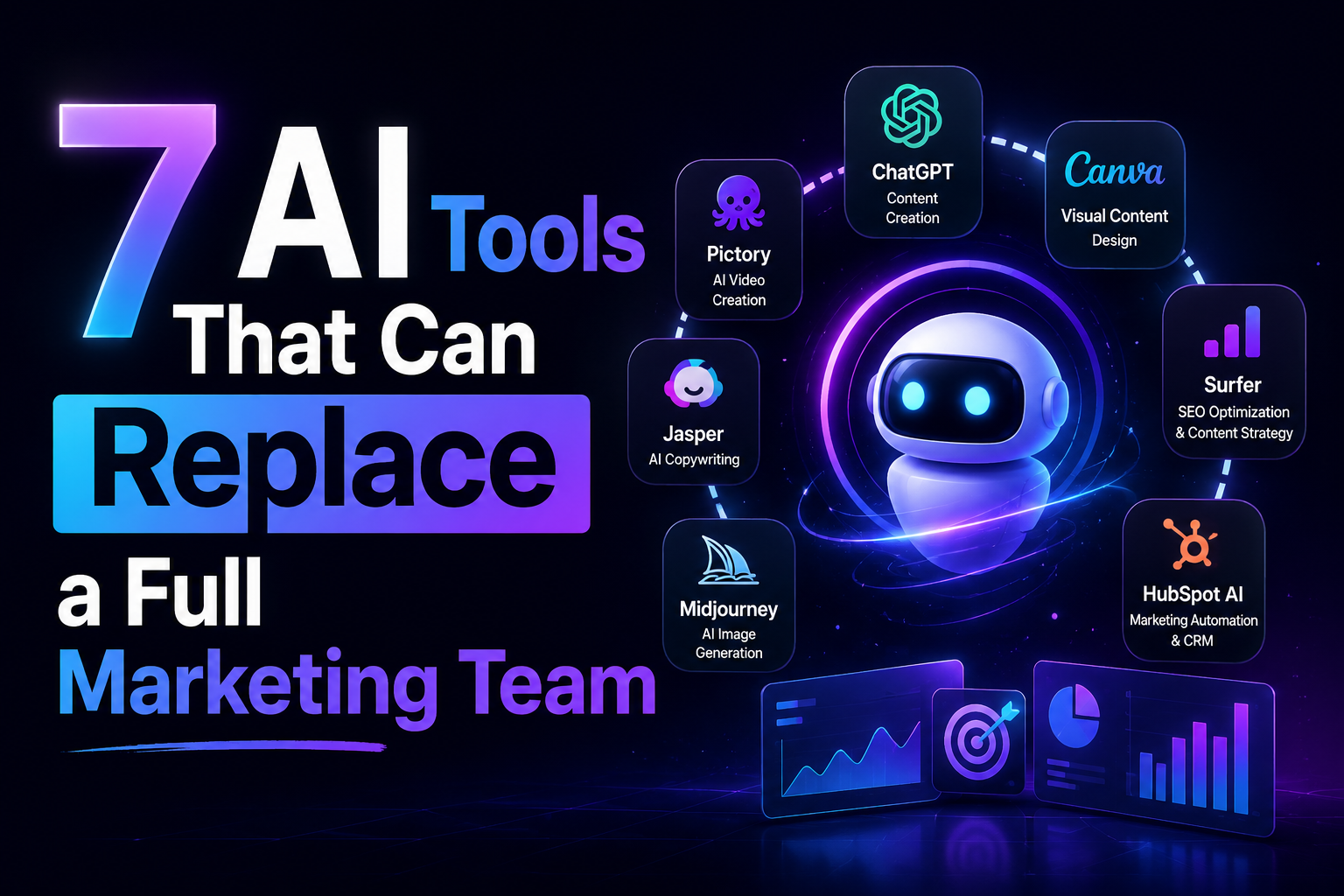
A full in-house marketing team — a copywriter, a designer, an SEO specialist, a social media manager, and an ads person — easily runs a small business six figures a year in salaries before a single campaign launches. In 2026, a solo founder or a two-person startup can cover most of that same ground with a stack of AI tools that costs less than one entry-level salary.
That doesn’t mean AI has made human marketers obsolete — strategy, brand judgment, and creative direction still benefit enormously from an experienced person steering the ship. But for the execution work that used to require a full team, these 7 tools now cover nearly every role, at a cost most solo entrepreneurs and small businesses can actually afford.
1. Jasper — The Copywriter
Replaces: the content writer drafting blog posts, ad copy, and email campaigns
Jasper remains one of the most established AI content platforms built specifically for marketing teams rather than general writing. Its standout feature, sometimes referred to as Jasper IQ, learns a business’s brand voice, style guide, and product details, so everything it drafts sounds consistently on-brand rather than generic. Its Content Pipelines can automate an entire workflow from a rough topic idea through to a publish-ready draft, covering blog posts, social captions, and email subject lines along the way.
Jasper is strongest for producing first drafts and pushing past writer’s block at volume — exactly the kind of repetitive drafting work that used to require hiring a dedicated content writer or freelance copywriter for a steady content calendar.
2. Canva Magic Studio — The Graphic Designer
Replaces: the designer producing social graphics, ads, and presentation decks
Canva has always been the default design tool for non-designers, and its Magic Studio suite folds AI directly into that workflow. Magic Write and Magic Design can generate marketing copy or entire design templates from a single prompt, while its AI image tools handle background removal, image expansion, and generating visuals from a text description entirely — tasks that would otherwise sit squarely on a designer’s plate.
For small businesses, the practical value here is speed: professional-looking social posts, ad creatives, and product mockups produced in minutes rather than requiring a design request to sit in a freelancer’s queue for days.
3. Semrush AI Toolkit — The SEO Specialist
Replaces: the SEO specialist doing keyword research, content audits, and competitor tracking
Semrush covers the full SEO workflow from one dashboard — keyword research, content audits, competitor analysis, and content strategy development — with several free AI-powered tools bundled in for proofreading, summarizing, rephrasing, and generating titles. It also integrates with specialized AI content tools like ContentShake AI for turning keyword research directly into optimized draft content.
This is the tool that most directly replaces the analytical, research-heavy side of marketing that used to require a dedicated SEO hire or an agency retainer — spotting technical site issues, identifying ranking opportunities, and tracking how content actually performs against competitors over time.
4. Sprout Social — The Social Media Manager
Replaces: the social media manager scheduling posts, tracking engagement, and handling inbound messages
Sprout Social’s AI Assist is one of the more sophisticated social media AI tools available in 2026, with real-time sentiment analysis that tracks mentions and direct messages across platforms, automatically categorizes tone, and flags emerging issues before they escalate into a real problem. Its automated response suggestions draft contextually relevant replies to inbound messages based on sentiment and content, with a human reviewing before anything actually sends — keeping quality high without the full time cost of a dedicated community manager reading every message individually.
For businesses managing several social accounts at once, this covers a genuinely time-consuming role: monitoring, responding, scheduling, and reporting on social performance without a person doing all of it manually.
5. HubSpot — The Marketing Automation and CRM Manager
Replaces: the person managing email campaigns, lead nurturing, and marketing-to-sales handoff
HubSpot’s AI content assistant drafts blog posts, social copy, and email campaigns directly inside a platform where every piece of content is already linked to a customer profile, giving a full view of each contact’s interactions across the funnel. Its automated workflows nurture leads collected from forms, ads, or landing pages without a person manually following up on every new contact, and its reporting dashboard tracks campaign performance in one place rather than across scattered spreadsheets.
This is the tool that most directly replaces the operational side of marketing — the follow-up emails, lead scoring, and campaign tracking that a marketing operations hire would otherwise own full-time.
6. AdCreative AI — The Paid Ads Specialist
Replaces: the person designing and testing ad creative for paid campaigns
AdCreative AI focuses specifically on generating ad creative and copy variations optimized for conversion, giving small businesses a way to test multiple ad concepts quickly without hiring a dedicated ads specialist or paying an agency for creative production on every campaign. It’s a narrower tool than the others on this list, but for any business actively running paid social or search campaigns, ad creative production is exactly the kind of repetitive, iterative work that eats a disproportionate amount of a marketer’s week.
7. AI Marketing Employee Platforms — The Marketing Coordinator
Replaces: the marketing coordinator tying everything else together
A newer category of tools has emerged in 2026 that goes beyond single-purpose software entirely: platforms offering role-specialized “AI marketing employees” for content, social media, SEO, email, and visuals under one roof, where a business sets a goal and specialized agents plan and produce the work for human approval, rather than a person operating each tool individually. These platforms won’t fully replace the judgment of an experienced marketing lead, but they meaningfully reduce the coordination overhead of stitching together five separate point solutions and manually keeping them working toward the same campaign goals.
For solo founders specifically, this category is worth watching closely — it’s the clearest sign yet that the AI marketing conversation is shifting from “tools that help you work faster” to “agents that execute the work directly,” with a human staying in the approval seat rather than the execution seat.
Quick Comparison: Tool, Role, and Starting Price
| Tool | Replaces | Starting Price |
| Jasper | Content writer / copywriter | Limited free plan; paid tiers scale up |
| Canva Magic Studio | Graphic designer | Free plan available; Pro from ~$15/mo |
| Semrush AI Toolkit | SEO specialist | Free tools available; paid from ~$117/mo |
| Sprout Social | Social media manager | 30-day free trial; from ~$199/mo per user |
| HubSpot | Marketing automation / CRM manager | Free plan available; scales by contacts/features |
| AdCreative AI | Paid ads specialist | Paid plans; no meaningful free tier |
| AI marketing employee platforms | Marketing coordinator | Typically from ~$45/mo |
Prices shift often in this category, so treat this table as a starting reference and confirm current rates directly with each provider before budgeting.
What AI Still Can’t Replace
None of this means a business can run entirely on autopilot. AI tools handle repetitive, time-consuming execution well — drafting, scheduling, formatting, first-pass analysis — but they still need clear human direction, brand judgment, and strategic thinking to actually work toward a coherent goal rather than just producing content for its own sake. The businesses getting the most value from this stack in 2026 are the ones treating AI as leverage for a lean team, not as a full replacement for having anyone making strategic calls at all.
There’s also a newer consideration worth flagging: with AI chatbots like ChatGPT, Perplexity, and Gemini increasingly answering questions directly rather than sending users to a search results page, small businesses now need to think about being cited by these AI systems, not just ranked in traditional search — a discipline some are already calling Generative Engine Optimization, alongside traditional SEO.
Realistic Costs Compared to Hiring
Pricing varies by tool and plan, but a realistic AI marketing stack — combining a content tool, a design tool, an SEO platform, and a social scheduling tool — typically runs somewhere between $150 and $400 a month for a small business, depending on which tiers and how many seats are needed. Compare that to the fully loaded cost of even one part-time marketing hire, let alone a five-person team, and the economics become obvious very quickly for early-stage businesses that can’t yet justify a full payroll.
The honest tradeoff: an AI stack requires someone — usually the founder — to still do the directing, reviewing, and approving. It replaces the execution hours, not the judgment. For a solo founder already wearing every hat, that’s still a substantial win; for a business that genuinely needs dedicated strategic thinking across multiple channels at once, AI tools are a force multiplier for an existing hire rather than a full substitute for one.
Frequently Asked Questions
Can AI really replace an entire marketing team? It can replace most of the repetitive execution work — drafting, designing, scheduling, and basic optimization — that used to require several specialized hires. Strategic direction, brand judgment, and creative decision-making still benefit from human oversight, even in an AI-heavy stack.
What’s the cheapest way to build an AI marketing stack? Start with free tiers where available — Canva, Semrush, and several social scheduling tools all offer functional free plans — and upgrade only the specific tool that’s clearly saving the most time once you’ve tested it against real work.
Is it worth paying for an all-in-one “AI marketing employee” platform instead of separate tools? It depends on how much time you’re currently losing to coordinating between separate tools. If campaign coordination itself is the bottleneck, an all-in-one platform can be worth the premium. If you already have a workflow that functions well, individual best-in-class tools for each role often perform better than a combined platform trying to do everything.
Do I still need a human marketer if I use all these tools? For most growing businesses, yes — at least for strategy and final review. These tools remove the execution burden, not the need for someone who understands your brand, audience, and goals well enough to direct the work and catch mistakes before they go public.
The Bottom Line
The marketing tasks that used to require a full team — writing, designing, researching keywords, managing social accounts, nurturing leads, and producing ad creative — can now be substantially covered by a stack of specialized AI tools for a fraction of a traditional payroll. That’s a genuine shift for solo founders and small businesses that couldn’t previously afford dedicated marketing headcount. The catch isn’t the tools themselves; it’s making sure someone is still steering them toward an actual strategy, rather than mistaking faster output for a real marketing plan.