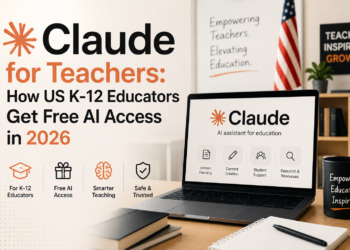


Claude for Teachers: How US K-12 Educators Get Free AI Access in 2026


On July 14, 2026, Anthropic launched Claude for Teachers, giving verified US K-12 educators a full year of free access to premium Claude features — including Claude Code and Claude Cowork, tools previously reserved for paying subscribers and developers. It’s a significant move in the increasingly crowded fight for classroom AI adoption, and it comes with more depth than a simple free trial: standards-aligned curriculum connections, a teaching-specific skills library, and student-data privacy terms co-developed with a national teachers’ union.
Here’s exactly who qualifies, what’s actually included, and how to sign up.
What Is Claude for Teachers?
Claude for Teachers is a dedicated, free offering built specifically for verified K-12 educators in the United States. It’s a separate initiative from Claude for Education, which Anthropic launched back in April 2025 targeting higher education institutions with a Socratic-questioning “Learning mode.” Claude for Teachers is narrower and more classroom-specific — built around the actual weekly workflow of a K-12 teacher rather than a general campus-wide deployment.
Anthropic frames the initiative around a specific problem: decades of education research point to practices like differentiation, mastery-based learning, and small-group instruction as reliable ways to improve student outcomes, but most teachers simply don’t have the time or resources to implement them consistently, especially in under-resourced schools. Claude for Teachers is positioned as a way to close that gap — not by replacing a teacher’s judgment, but by handling the time-consuming preparation work that usually stands between a good instructional idea and actually delivering it in class.
Who Qualifies
Eligibility is specific and currently limited to one country:
- Location: US K-12 educators only, at this stage.
- Verification: Teachers must confirm their employment using an official school email address. This is the core verification mechanism — there’s no separate document upload or manual review process beyond confirming a legitimate school-affiliated email.
- Enrollment window: The program is open for signup through June 30, 2027, with verified educators receiving a full year of premium access from the point they sign up.
It’s worth being clear about who this program does not cover: it’s built for teachers, not students. There’s currently no equivalent “Claude for Students” free program under this initiative — students benefit indirectly, through teachers using Claude to prepare differentiated lesson plans, assessments, and classroom materials, rather than through direct free access of their own.
What’s Actually Included
Claude for Teachers goes well beyond simply waiving the subscription fee for standard Claude. Verified teachers get:
- Premium Claude access, including capabilities normally reserved for paid plans.
- Claude Code and Claude Cowork, the platform’s agentic tools that let Claude carry a multi-step task forward independently rather than requiring a teacher to prompt it at every step — useful for tasks like reviewing a stack of exit tickets or generating a full week’s worth of differentiated materials from a single instruction.
- A Learning Commons connector, giving direct access to academic standards mapped across all 50 US states, along with trusted curricula from sources like OpenSciEd and Illustrative Mathematics.
- A dedicated teaching skills library, co-developed with Learning Commons and grounded in learning science, covering the specific tasks teachers identified as mattering most — generating differentiated lesson plans, producing standards-aligned assessments, creating math diagrams, and turning existing materials into classroom-ready, interactive formats.
- Nine edtech integrations, built as Model Context Protocol (MCP) connectors, positioning Claude as an integration layer that other education-technology tools can build on top of, rather than a single closed product competing alongside them.
Student Data Privacy: What Teachers Need to Know
Given how much of this program involves handling actual student information — rosters, diagnostics, attendance, and performance data — Anthropic built specific privacy terms around it, developed in partnership with the American Federation of Teachers (AFT) toward what the company describes as a “Gold Standard” for safety and privacy in K-12 AI tools.
The key detail: training is disabled by default for verified teacher accounts. Anthropic states explicitly that student data fed into Claude for Teachers — a class roster, diagnostic results, attendance records — is not used to train its models. For any teacher considering handing over sensitive student data to build a class-wide instructional picture, this is the detail worth confirming and understanding before uploading anything, even with that assurance in place.
How to Sign Up
The enrollment process is designed to be straightforward:
- Visit Anthropic’s official Claude for Teachers signup page (linked from Anthropic’s news page).
- Register using your official school-issued email address — this is the primary verification step.
- Complete identity confirmation as a K-12 educator.
- Once verified, gain access to Claude for Teachers, including the Learning Commons connector and the teaching skills library, from your existing or newly created Claude account.
There’s no cost at any point in this process for eligible educators, and access runs for a full year from the point of verification, with the enrollment window itself open through June 2027.
How Claude for Teachers Compares to Competitors
Claude for Teachers enters a genuinely competitive field. OpenAI launched ChatGPT for Teachers several months earlier, and Microsoft and Google have both been steadily embedding AI into their existing education product lines — Microsoft Elevate for Educators and Google’s AI Educator Series. What differentiates Claude for Teachers isn’t simply that it’s free; several competitors offer comparable no-cost access. The distinguishing factor is the depth of integration: the standards-aligned Learning Commons data layer, an open-source teaching skills repository other developers can build on, and full inclusion of Claude’s agentic tools (Code and Cowork) rather than a stripped-down chatbot-only version.
For a school or district evaluating multiple free AI offerings at once, that structural depth — standards alignment, an actual research-grounded skills library, and open integration protocols — is the practical differentiator worth weighing beyond the shared “free” headline.
Practical Ways Teachers Are Already Using It
Based on how Anthropic and early pilot programs describe real classroom use, teachers are applying Claude for Teachers to a fairly consistent set of recurring tasks: drafting differentiated lesson plans that adjust for different student skill levels without writing three separate versions from scratch, generating standards-aligned assessments tied directly to a state’s specific academic requirements, producing classroom-ready math diagrams and visual aids, and automating repetitive review work like processing daily exit tickets across an entire class. The common thread across all of these is time reclaimed from evening and weekend prep work — precisely the burden Anthropic frames as the core problem the program is meant to address.
Why This Launch Matters Beyond the Free Access
[IMAGE 4 — Abstract image representing connected education technology or a network of school resources. Suggested search: “education technology network connection concept” on Pexels. Alt text: “Claude for Teachers and the broader AI in education movement”]
Anthropic’s choice to build Claude for Teachers on the Model Context Protocol (MCP) — the same open standard the company has been developing as broader industry infrastructure since late 2024 — signals an ambition beyond a single free product. By releasing the underlying teaching skills library as open-source and building the nine edtech integrations as standardized MCP connectors, Anthropic is positioning Claude as a layer other education-technology companies can build on top of, rather than a closed product competing in isolation against ChatGPT for Teachers or Microsoft Elevate.
For school districts and edtech developers, this matters practically: any tool built to the same MCP standard becomes Claude-compatible by default, which could meaningfully expand what teachers can connect to Claude for Teachers over time without Anthropic needing to build every individual integration itself. It’s a similar playbook to how open standards have historically expanded a platform’s usefulness faster than a single company building every feature in-house.
There’s also a broader context worth noting: this launch follows Anthropic’s January 2026 partnership with Teach For All, a global education network spanning 63 countries, which gave more than 100,000 teachers access to AI fluency training. Claude for Teachers builds directly on that groundwork, extending from training teachers on AI concepts to giving them a concrete, free tool built around actual classroom tasks.
What Schools and Districts Should Consider Before Rolling This Out
Even with strong privacy terms in place, individual teachers signing up independently is different from a school or district adopting a tool at scale. Administrators considering a broader rollout should factor in a few practical questions beyond the headline “it’s free”: how the tool fits alongside existing district-approved edtech policies, whether IT staff need to review the Learning Commons data connections before teachers start uploading roster or diagnostic information, and how the district plans to train staff on using the teaching skills library effectively rather than leaving individual teachers to figure it out through trial and error.
None of this changes the core value proposition — a genuinely capable, privacy-conscious AI tool at no cost is a meaningful resource for any school working with a tight budget. But a coordinated rollout, rather than scattered individual signups, tends to get more consistent value out of a tool this deep, particularly given how much of its usefulness comes from the standards-aligned curriculum connections rather than the chatbot interface alone.
Frequently Asked Questions
Is Claude for Teachers available to students directly? No. The program is specifically for verified K-12 teachers, not students. Students benefit indirectly through the materials and instruction their teachers produce using the tool, but there’s currently no separate free-access program for students themselves under this initiative.
Is Claude for Teachers available outside the United States? As of its July 2026 launch, the program is limited to US K-12 educators. Anthropic hasn’t announced an international expansion timeline as of this writing.
How long does the free access last? Verified teachers receive a full year of premium access from the point of signup, with the enrollment window itself open through June 30, 2027.
Does Claude use student data to train its models? No. Anthropic states that training is disabled by default for verified teacher accounts, meaning student data uploaded through the program — rosters, diagnostics, attendance records — isn’t used to train Claude’s models.
What’s the difference between Claude for Teachers and Claude for Education? Claude for Education, launched in April 2025, targets higher education institutions with a Socratic-questioning Learning mode designed for student use. Claude for Teachers, launched in July 2026, is a separate, narrower program built specifically for K-12 teachers’ instructional workflow rather than direct student use.
The Bottom Line
Claude for Teachers is one of the more substantial free AI offerings currently available to educators — not just a waived subscription fee, but a genuinely classroom-built toolkit with standards alignment, agentic task automation, and privacy terms developed alongside a national teachers’ union. For any US K-12 teacher currently spending evenings and weekends on lesson prep, differentiated materials, or assessment creation, verifying eligibility with a school email is a low-effort way to test whether it actually reduces that workload — and with the enrollment window open through mid-2027, there’s no urgency pressure to decide immediately.