

SciSpace AI Detector Review: How Accurate Is It Really in 2026?


AI-generated text has become common enough in classrooms and research submissions that “is this actually AI detection software accurate” is now a genuinely important question, not a niche technical one. SciSpace, a platform already popular with researchers for literature reviews and paper summarization, built an AI Detector feature squarely aimed at this problem — advertised at a striking 98% accuracy rate.
That number sounds decisive. Independent testing tells a messier, more useful story. This review breaks down exactly what SciSpace AI Detector does, how it performed in real tests, what it costs, and who it’s actually a good fit for.
What Is SciSpace AI Detector?
SciSpace AI Detector is a feature built into the broader SciSpace platform, a tool researchers and students already use for reading, summarizing, and reviewing academic papers. The detector is specifically tuned for scholarly and academic writing rather than general web content, which sets it apart from broader-purpose detectors built mainly for marketing copy or blog posts.
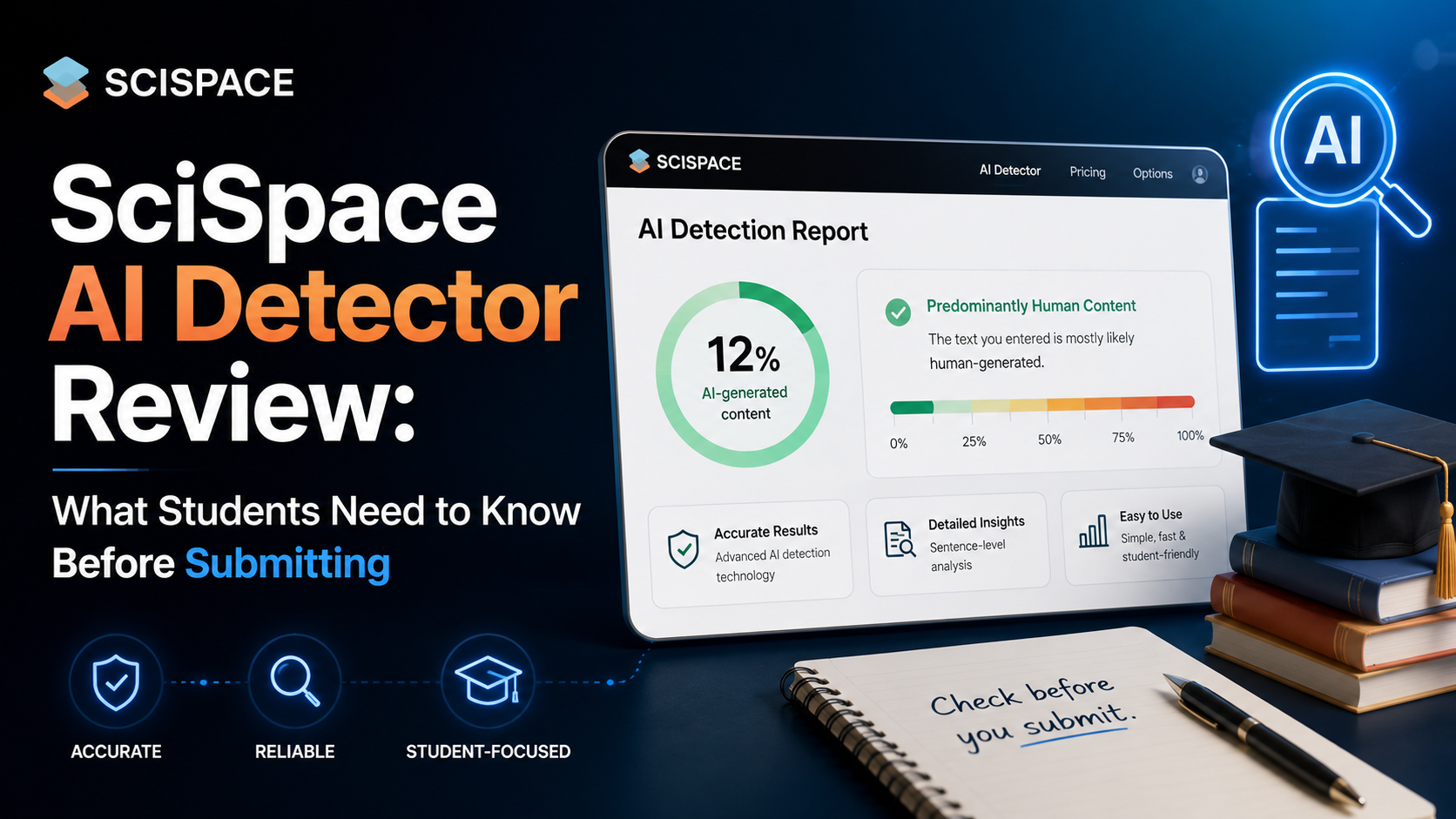
The tool analyzes text at the sentence level, looking at patterns, syntax, word choice, and sentence rhythm commonly associated with machine-generated writing. It’s designed to catch content produced by tools like ChatGPT, GPT-4, and Jasper, and it accepts both pasted text and uploaded PDF documents. After analysis, it returns a report at both the whole-document level and the individual-sentence level, highlighting exactly which portions it flags as likely AI-generated.
Key Features
- Sentence-level breakdown. Rather than a single document-wide score, SciSpace highlights specific sentences it believes are AI-generated, which makes it easier to identify exactly where a flagged section sits rather than guessing at which parts triggered the score.
- PDF and text support. You can paste raw text directly into the editor or upload a full document, which matters for anyone working with finished papers rather than drafts still living in a word processor.
- Academic-specific tuning. Unlike general-purpose detectors, SciSpace is specifically calibrated for essays, assignments, and scholarly writing, which the company argues gives it an edge on the kind of formal, structured prose that academic work tends to use.
- Detection across multiple AI writers. The tool is built to catch output from several popular AI writing tools, not just one, including general-purpose chatbots and dedicated AI writing assistants.
- Bundled into the broader SciSpace platform. The detector isn’t sold as a standalone product — it comes as part of a subscription that also includes SciSpace’s literature review and research assistant tools, which is worth knowing if you only want the detector itself.
How Accurate Is It, Actually?
This is where the marketing claim and real-world testing start to diverge in an important way. SciSpace advertises a 98% accuracy rate, and in several independent tests on fully human-written or fully AI-generated text, the tool performed reasonably well, correctly flagging heavily AI-generated content and, on YouTube-documented tests, reportedly outperforming some competitors on outright AI-versus-human comparisons.
The complications show up on blended and edge-case content. In one detailed independent review, testers ran a passage that was mostly human-written with only a small AI-generated portion mixed in. SciSpace flagged 91% of the text as AI-generated, correctly identifying only about 19% as human — a significant overestimation that mislabeled a large amount of genuinely human writing. That same review found the tool held up better against lightly humanized AI text: when 100% AI-generated content was run through a basic paraphrasing tool to try to disguise it, SciSpace still correctly flagged all of it as AI-generated, suggesting it’s genuinely sensitive to the kind of mechanical sentence patterns that light humanization doesn’t fully remove.
Other independent testing has documented occasional false positives as well — human-written content misclassified as AI-generated, which is the single most consequential failure mode for any detector used in an academic integrity context, since a false accusation carries real consequences for a student or researcher.
The honest summary: SciSpace performs competently at the extremes — clearly AI text and clearly human text — but its accuracy drops meaningfully on mixed or blended content, which is precisely the kind of writing many real students and researchers actually produce when they use AI tools for brainstorming or light editing rather than generating an entire paper from scratch.
Pricing
SciSpace AI Detector isn’t available as a standalone purchase — it’s bundled into SciSpace’s broader subscription plans, alongside the platform’s research and literature review tools. As of 2026, pricing breaks down as follows:
| Plan | Price | What’s Included |
|---|---|---|
| Free | $0/month | Limited AI detection features, limited credits |
| Premium | $12/month (billed annually) or $20/month (monthly) | Full AI Detector access, unlimited literature searches, higher-quality models |
| Advanced | $70/month (billed annually) or $90/month (monthly) | Everything in Premium, plus higher usage limits and advanced model access |
| Teams | From $18/user/month | Role management, admin tools, dedicated support |
| Enterprise | Custom pricing | Institutional-scale needs, SLAs, dedicated support |
For anyone who only wants the detector and doesn’t need SciSpace’s other research features, this bundled pricing structure is worth factoring in — you’re paying for a full research platform, not a single-purpose detection tool.
How the Detection Process Actually Works
Using the tool itself is straightforward, which is part of its appeal for non-technical users. You either paste text directly into SciSpace’s editor or upload a document — PDF or plain text both work. The system then processes the content and returns a report within roughly a minute for a standard-length paper, showing an overall percentage score alongside a sentence-by-sentence breakdown.
The sentence-level view is genuinely more useful than a single headline number, because it lets you actually see which specific claims the tool is making rather than trusting a single aggregate score. If three sentences in a ten-paragraph essay get flagged, you can go look at exactly those three sentences and make your own judgment about whether the flag makes sense — a much more actionable workflow than a document simply being labeled “68% AI-generated” with no further detail.
That said, the report is a starting point, not a verdict. The tool doesn’t explain why a given sentence was flagged beyond the general category of pattern it matched, so users still need to apply their own judgment about context — a technical or scientific sentence with unusually formal phrasing can trigger the same pattern-matching signals as genuine AI output, which is part of why blended, formally-written academic content is where the tool’s accuracy struggles most.
What Independent Reviewers Are Saying
Coverage of SciSpace AI Detector across independent review sites has been fairly consistent in its conclusions, even when the specific test results differ slightly. Most reviewers agree the tool is a solid, above-average option specifically within the academic-writing category, largely because of its sentence-level reporting and its tuning toward scholarly prose rather than generic web content. Several reviewers who tested it against competitors like Winston AI and Originality.ai found SciSpace held its own on straightforward test cases, while noting the same blended-content weakness that shows up across nearly the entire AI detection category — this isn’t a problem unique to SciSpace so much as a current limitation of how AI detection technology works in general as of 2026.
The consistent theme across reviews: treat any AI detector’s score as directional evidence, not a definitive verdict, and be especially cautious about applying it to any writing that mixes AI assistance with genuine human editing and revision — which describes an enormous share of real student and researcher writing today.
Pros and Cons
Pros:
- Strong performance on clearly AI-generated or clearly human-written text
- Sentence-level reporting makes flagged content easy to locate and review
- Holds up reasonably well against lightly humanized or paraphrased AI text
- Supports both pasted text and full PDF document uploads
- Tuned specifically for academic writing rather than general web content
Cons:
- Accuracy drops noticeably on blended human-and-AI text, a common real-world scenario
- Documented false positives, misclassifying genuine human writing as AI-generated
- Not available as a standalone product — requires a broader SciSpace subscription
- English-language support only, which limits its usefulness for multilingual institutions
- The advertised 98% accuracy figure reflects best-case conditions, not the tool’s performance across all content types
Who Should Actually Use It
SciSpace AI Detector is a reasonable fit for individual students and researchers who already use or are considering SciSpace’s broader research toolset — the detector becomes a genuinely useful bonus feature rather than the main reason to subscribe. It’s also a sensible option for anyone specifically checking academic-style writing, since the tool’s tuning toward scholarly prose gives it an edge over general-purpose detectors on that particular kind of formal writing.
It’s a weaker fit for institutions that need a single, defensible tool for formal academic integrity enforcement, given the documented false-positive rate on mixed content. Given how consequential a false AI-generation accusation can be for a student, any institution using SciSpace or any similar detector for disciplinary decisions should treat its output as one data point requiring human judgment and follow-up conversation, not as a standalone verdict.
How It Compares to Other AI Detectors
Among academic-focused detectors, SciSpace competes most directly with tools like Winston AI, which adds plagiarism detection and OCR support alongside AI detection, and general-purpose detectors like Originality.ai, which is more commonly used by bloggers, SEO professionals, and content marketers rather than academic institutions specifically. SciSpace’s advantage over these broader tools is its specific tuning for scholarly writing patterns; its disadvantage is the same one shared by nearly every AI detector currently on the market — none of them are reliable enough on mixed or lightly-edited content to be used as a sole, unquestionable source of truth.
Frequently Asked Questions
Is SciSpace AI Detector actually 98% accurate? On clearly AI-generated or clearly human-written text, its performance in independent tests has generally been strong. On blended content — a mix of human and AI writing in the same document — accuracy drops significantly, with at least one independent test showing a large overestimation of AI content in a mostly human-written passage.
Can SciSpace AI Detector be fooled by AI humanizer tools? In documented testing, lightly humanized AI text (run through basic paraphrasing) was still correctly flagged as AI-generated. Whether more sophisticated humanization tools can bypass it consistently hasn’t been thoroughly tested in public reviews, so treat this as an open question rather than a settled answer.
Does SciSpace AI Detector give false positives? Yes, documented cases exist of human-written content being misclassified as AI-generated, particularly in blended or edge-case writing. This is a limitation shared by essentially every AI detector currently available, not something unique to SciSpace.
Can I buy SciSpace AI Detector on its own? No. It’s bundled into SciSpace’s broader subscription plans alongside the platform’s research and literature review tools, starting with a limited free tier and scaling up through Premium, Advanced, and Team plans.
Is SciSpace AI Detector good enough to use for formal academic discipline decisions? It shouldn’t be used as a sole source of truth for any formal disciplinary action. Given its documented accuracy drop on mixed content and occasional false positives, its output is best treated as a starting point for a conversation with a student, not as standalone proof.
The Bottom Line
SciSpace AI Detector is a genuinely useful tool for anyone already inside the SciSpace ecosystem who wants a quick, academic-tuned check on a piece of writing — and it performs credibly at the extremes, catching clearly AI-generated text reliably, including some lightly disguised versions of it. Where it falls short is exactly where most AI detectors currently fall short: content that blends human and AI writing, which is increasingly the norm rather than the exception. The advertised 98% accuracy figure is real under the right conditions, but it isn’t the whole story. Use SciSpace AI Detector as a helpful first pass, not a final verdict — and if a flagged result carries real consequences for someone, always follow it up with human judgment before acting on it.